The International Monetary Fund expects economic growth across Asia-Pacific to slow as higher energy prices, tighter global financial conditions and the possibility of a correction in artificial-intelligence investment create new pressure across the region.
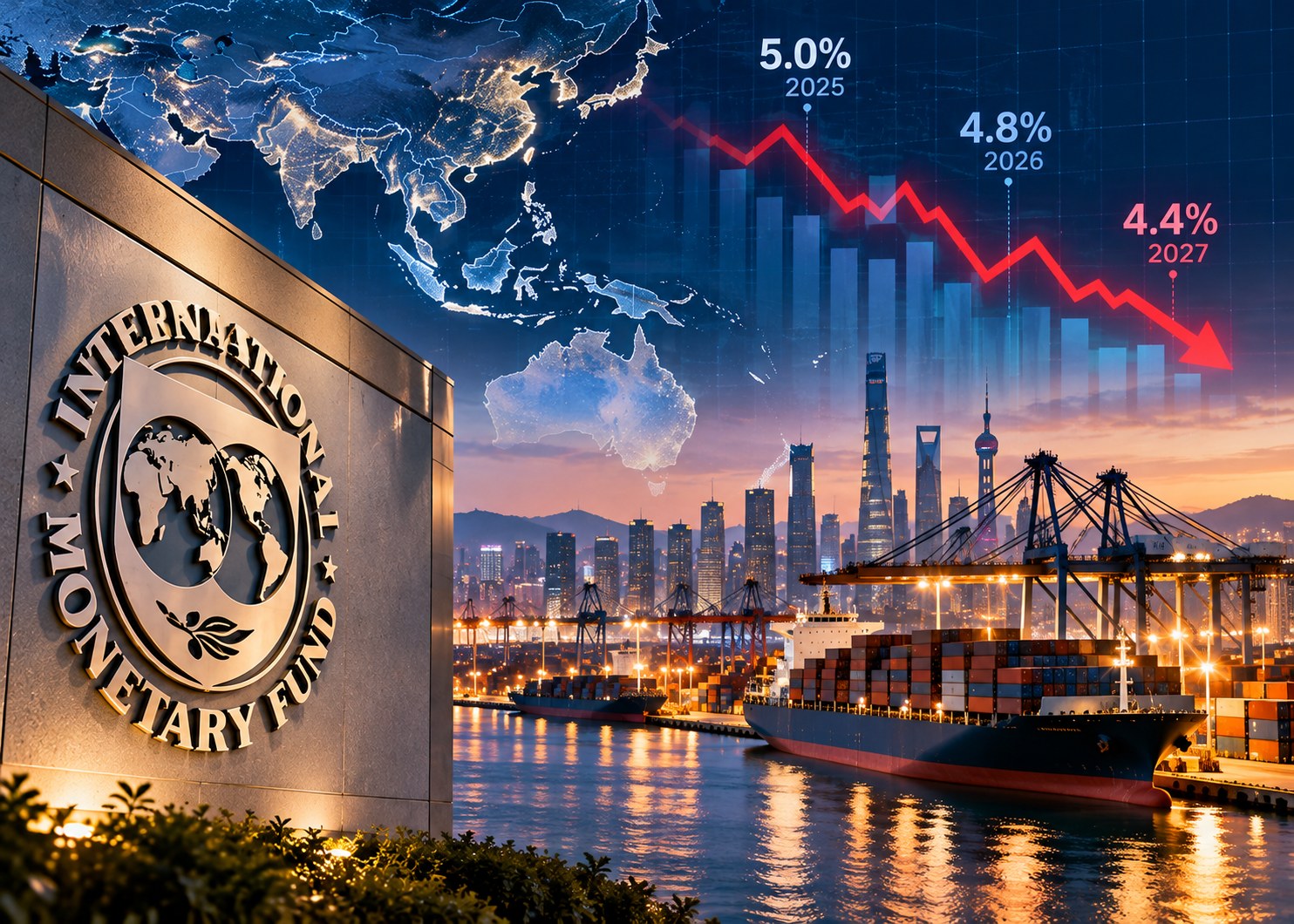
The IMF projects regional growth of 4.8% in 2026 and 4.4% in 2027, compared with 5.0% in 2025.
Although the 2026 projection represents an improvement from the IMF’s earlier forecast, the overall trajectory still points toward slower growth.
The risks are increasingly interconnected.
Higher energy prices resulting from Middle East disruptions are raising inflation and import costs across energy-dependent Asian economies.
At the same time, elevated global government-bond yields and uncertainty surrounding U.S. monetary policy threaten to increase borrowing costs and financial-market volatility across the region.
Artificial intelligence creates another source of both opportunity and vulnerability.
The AI investment boom has helped technology-heavy Asian economies, particularly countries deeply integrated into semiconductor and electronics supply chains.
South Korea and Taiwan have been among the strongest beneficiaries, contributing to significant upgrades in their economic outlooks.
But that exposure works in both directions.
A substantial correction in global AI investment could disproportionately affect economies whose manufacturing sectors have become increasingly dependent on demand for semiconductors, servers and other computing infrastructure.
The IMF’s assessment therefore highlights a widening divide within Asia between economies benefiting from the technology investment cycle and countries facing higher inflation without comparable AI-related growth.
Asia remains responsible for a substantial share of global economic expansion, making the region’s ability to absorb these shocks important well beyond its borders.
For investors, the next question is whether continued technology investment can offset higher energy costs, expensive global financing and weaker growth as the region moves into 2027.