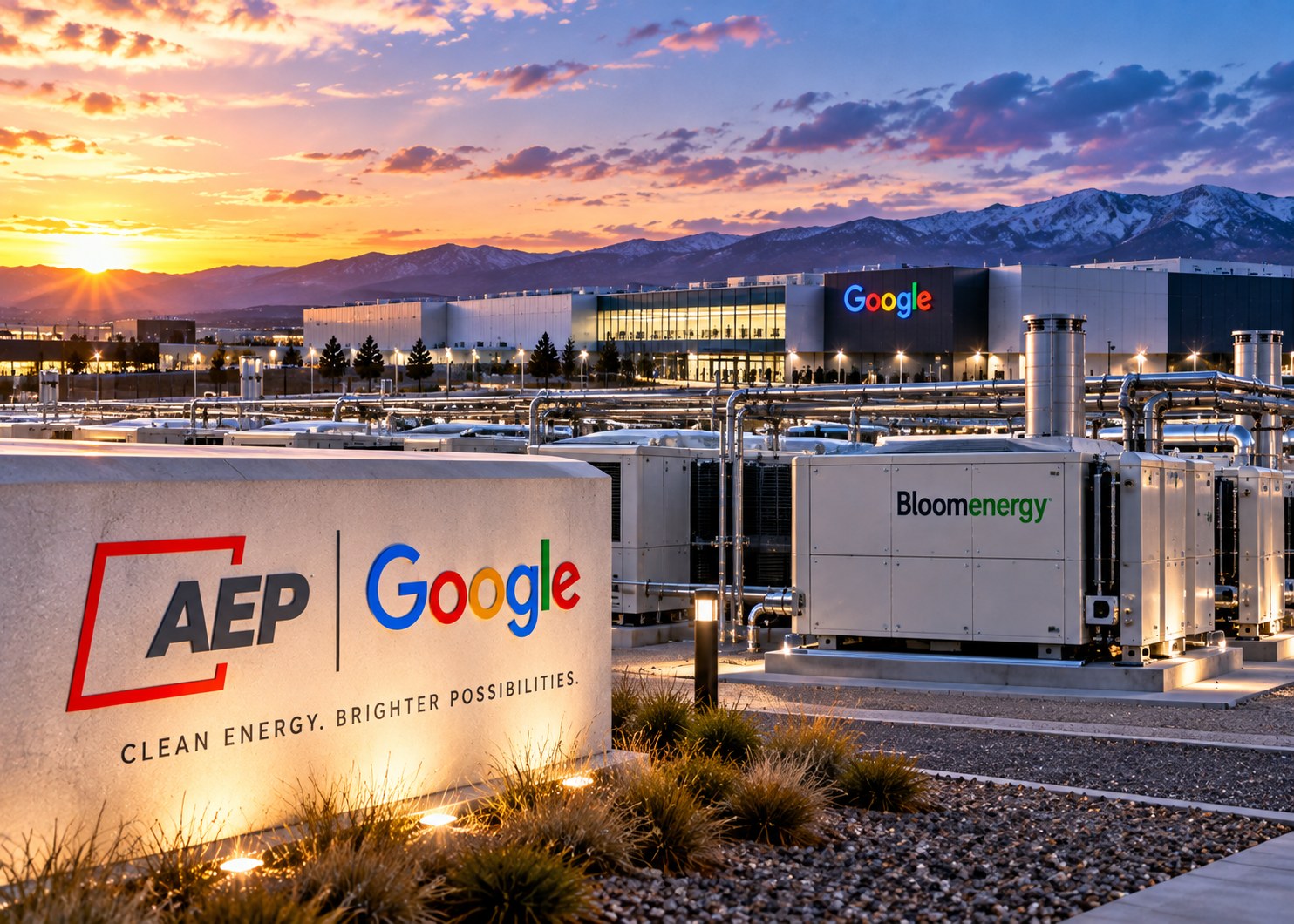
American Electric Power plans to invest approximately $4 billion in a 702-megawatt fuel-cell generation project near Cheyenne, Wyoming, to supply electricity to Google’s expanding operations.
The companies have signed a 20-year power-purchase agreement covering the project.
Construction is expected to begin in 2026, with the facility scheduled to reach full operation by the end of 2028.
The project will be developed through Cheyenne Fuel Cell, which is approximately 92% owned by AEP. Funds managed by Basalt Infrastructure Partners hold the remaining interest.
The facility will use fuel-cell technology developed by Bloom Energy.
The investment illustrates the increasingly direct connection between artificial-intelligence development and U.S. power infrastructure.
Data centers require enormous quantities of reliable electricity, but construction of conventional power plants and transmission infrastructure can take years.
Technology companies and utilities are therefore exploring dedicated generation and alternative power arrangements capable of supporting rapidly expanding computing facilities.
AEP has already expanded its relationship with Bloom Energy. Earlier this year, the utility agreed to acquire a substantial portion of as much as 900 megawatts of additional Bloom fuel cells in a separate transaction valued at approximately $2.65 billion.
The Wyoming project demonstrates how the AI capital-spending cycle is moving beyond semiconductors, servers and data centers into utilities and electricity generation.
That creates potential opportunities for power producers, utilities, fuel-cell manufacturers and companies involved in building the infrastructure required to support hyperscale computing.
For investors, the key question is whether rapidly increasing electricity requirements from AI and cloud computing create a sustained new source of growth for U.S. utilities and distributed-generation technologies.