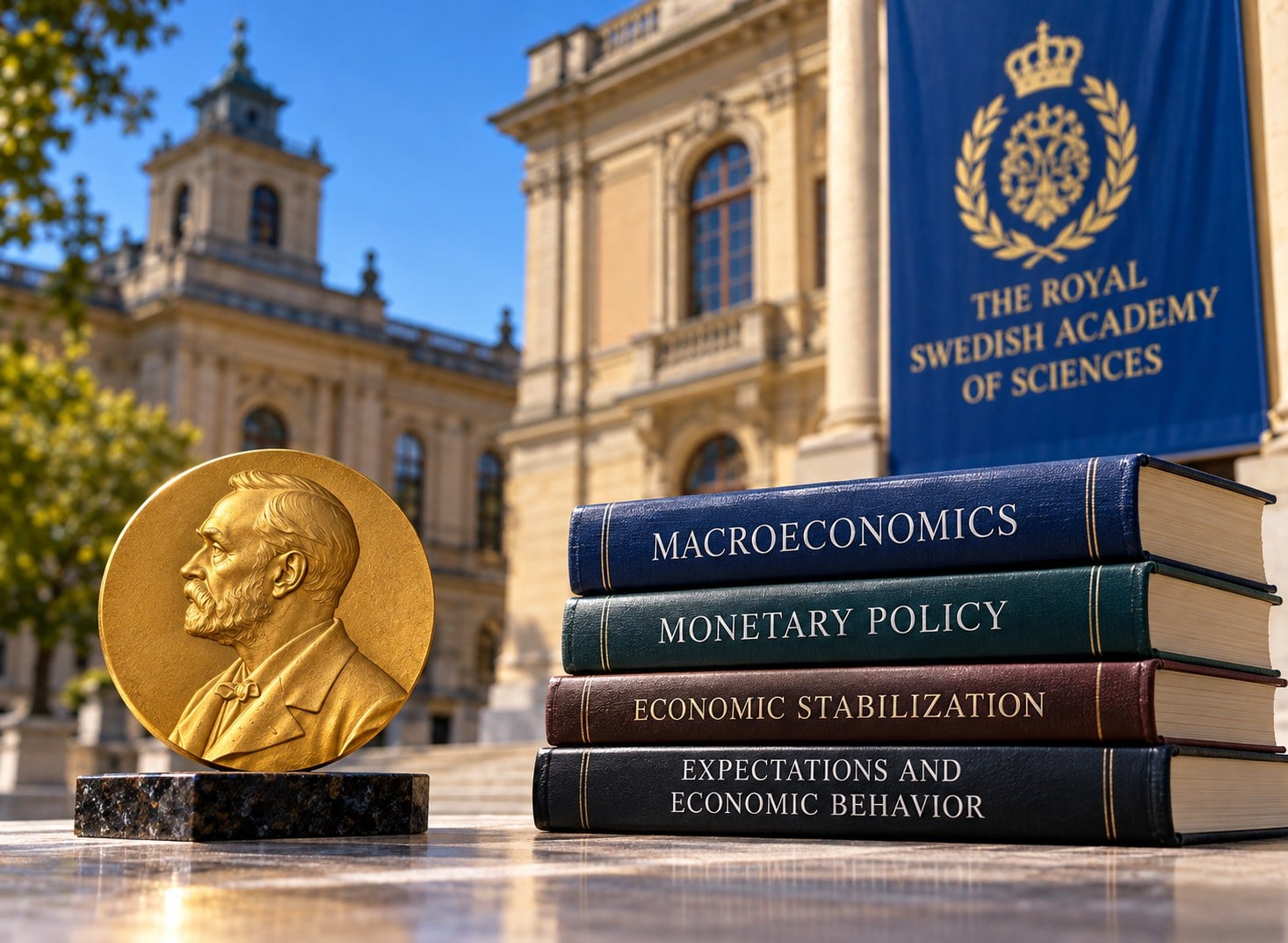
American economists Robert E. Hall and Michael Woodford have won the 2026 Sveriges Riksbank Prize in Economic Sciences for research that helped reshape the way central banks and governments model economic stabilization.
The Royal Swedish Academy of Sciences awarded the pair the 12 million Swedish crown prize for work on the microeconomic foundations of macroeconomic stabilisation.
Their research helped move macroeconomic modeling away from relying primarily on historical relationships among broad variables and toward models built around how households and businesses respond to incentives and expectations.
Those ideas became central to New Keynesian economic models now widely used by central banks and finance ministries.
Woodford’s research also became influential in the development of forward guidance — the practice of using communication about future monetary policy to influence current financial conditions and economic behavior.
The relevance is particularly clear in the current environment.
Central banks are again confronting simultaneous pressure from elevated energy prices, inflation uncertainty and changing expectations about interest rates. The models developed from Hall and Woodford’s work were designed specifically to help policymakers understand how expectations and individual behavior transmit policy through the broader economy.
The award does not settle debates over the effectiveness of forward guidance or modern macroeconomic models. Instead, it recognizes the framework that has shaped a large portion of contemporary monetary-policy analysis.
Hall is affiliated with Stanford University, while Woodford is affiliated with Columbia University.
For investors, their work is visible every time markets react not only to what a central bank does with interest rates today, but to what policymakers signal they may do months into the future.