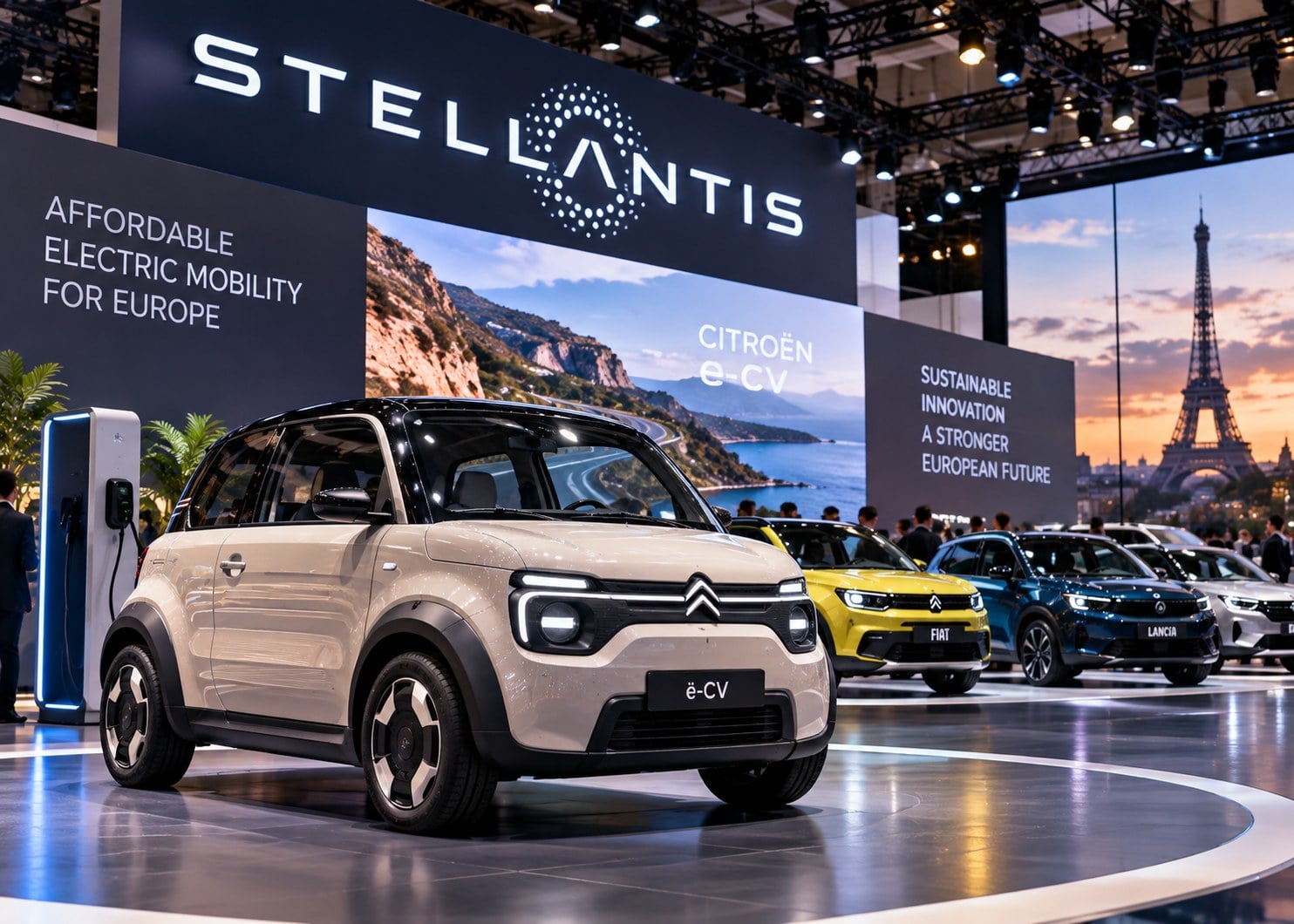
Stellantis is betting that a new generation of roughly €15,000 electric vehicles can help reverse years of market-share losses in Europe and strengthen its position against lower-cost Chinese competitors.
Chief Executive Antonio Filosa used a Sunday event ahead of the Paris Motor Show to showcase six of nine concept vehicles the automaker is bringing to the exhibition.
The centerpiece is an electric revival of Citroën’s 2CV.
The concept previews a European-built low-cost EV expected in 2028 and is intended to demonstrate how Stellantis could compete in Europe’s emerging “e-car” category.
The category targets one of Europe’s most difficult automotive problems.
Battery-electric vehicles remain comparatively expensive for many mass-market consumers, while Chinese manufacturers have used lower production costs and aggressive pricing to expand their European presence.
Approximately €15,000 would place the emerging e-car category substantially below many conventional European EVs.
Stellantis is simultaneously trying to recover from years of weak European sales and declining market share.
Its shares remain near record lows despite a broader turnaround plan.
The company’s Paris lineup also includes new vehicles and concepts across DS, Fiat, Lancia and Opel, alongside models from Chinese partner Leapmotor.
That mix reflects two parallel strategies: rebuilding the identities of Stellantis’ European brands while using partnerships and lower-cost platforms to compete in increasingly price-sensitive EV segments.
The economics will be the critical test.
European manufacturers need to lower EV prices without sacrificing margins, safety or product quality while competing against Chinese companies operating with highly integrated supply chains.
Stellantis’ planned 2028 low-cost EV therefore represents more than another model launch.
It will test whether a major European manufacturer can profitably defend the entry-level market as electrification accelerates.