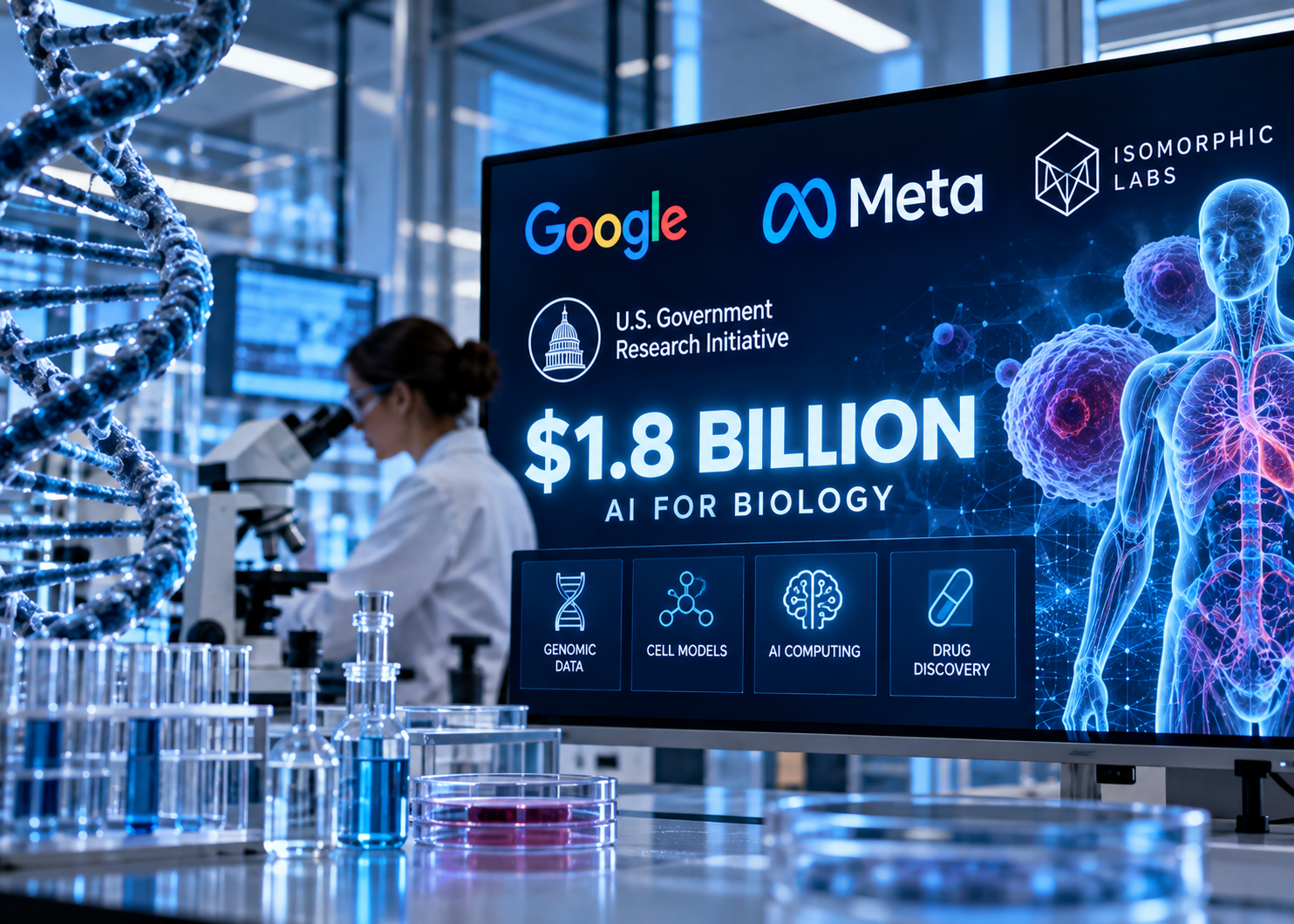
The U.S. government and major technology organizations are joining an expanded $1.8 billion initiative designed to create massive biological datasets for artificial intelligence and eventually develop predictive models of human cells.
Meta, Google DeepMind and AI drug-discovery company Isomorphic Labs are jointly committing $300 million to the initiative.
The U.S. Department of Energy plans to contribute more than $500 million over five years toward laboratory measurements, modeling and computing.
The National Institutes of Health will coordinate datasets and repositories created using more than $500 million of previous federal investment, while Biohub previously committed another $500 million.
The project, known as the Virtual Biology Initiative, is designed to generate large standardized datasets showing how cells and biological systems behave under different conditions.
Those datasets could eventually allow researchers to train AI systems capable of predicting biological responses before experiments are performed in physical laboratories.
That could have significant implications for drug discovery and disease research by allowing scientists to test some hypotheses computationally before committing additional time and resources to laboratory work.
The initiative also represents another stage in AI infrastructure development.
Artificial intelligence investment is moving beyond language models, image generation and software development into scientific fields where specialized datasets may become as strategically important as computing power.
The scientific challenge remains substantial. Predictive biological models will still require extensive experimental validation, and their usefulness will depend heavily on the quality and diversity of the underlying data.
But the scale of government, philanthropic and technology-sector participation makes the initiative one of the largest coordinated attempts yet to construct an open data foundation for AI-driven biology.