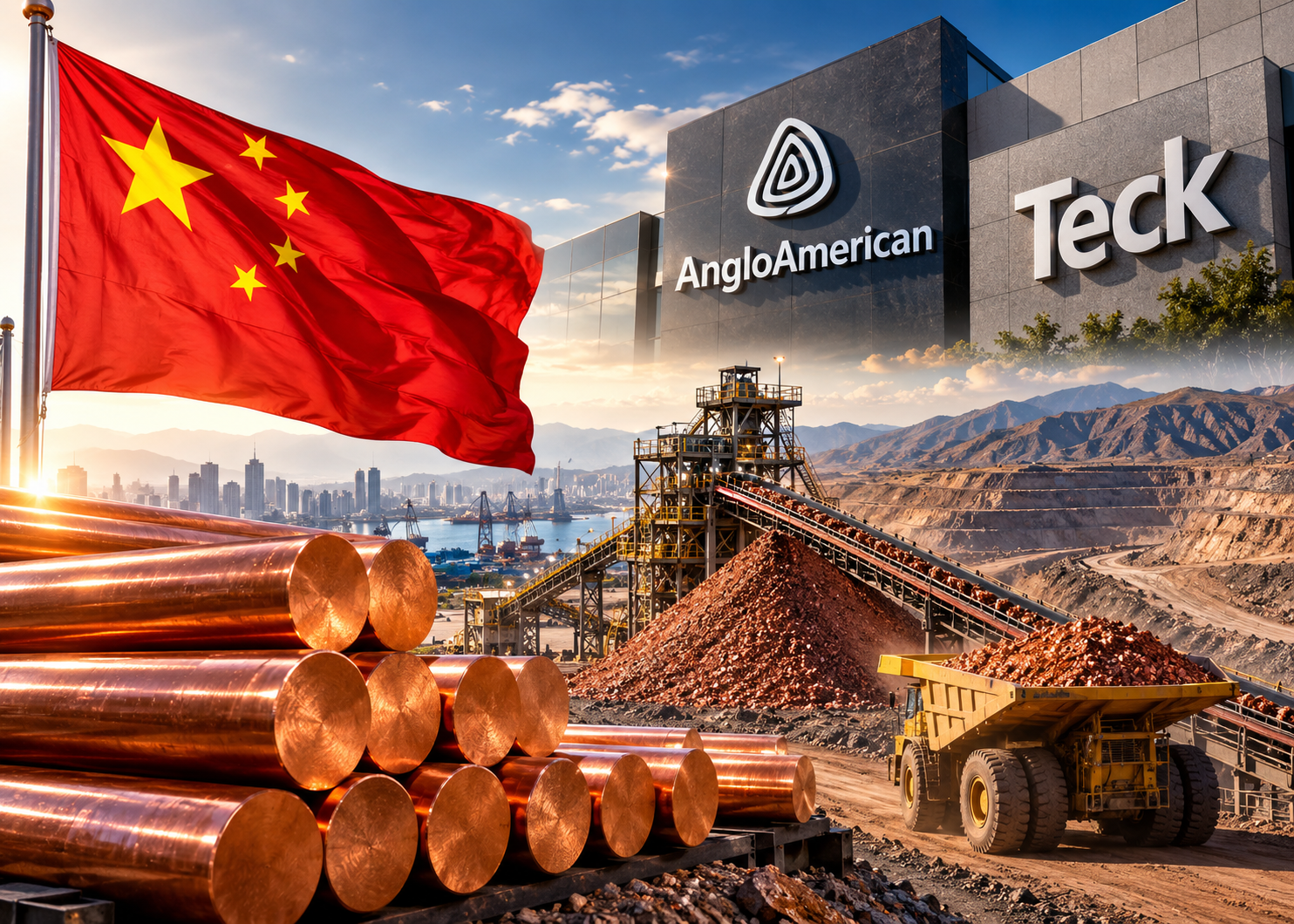
China’s antitrust regulator is seeking copper-supply commitments from Anglo American before approving its proposed $54 billion merger with Canada’s Teck Resources, introducing a significant final regulatory issue for one of the mining industry’s largest transactions.
China’s State Administration for Market Regulation is seeking assurances that copper concentrate produced by the combined company will continue flowing to Chinese smelters, according to people familiar with the negotiations.
The request reflects China’s enormous role in the copper industry.
China refines as much as 60% of the world’s copper cathodes, making secure access to concentrate essential for a domestic smelting industry already dealing with unusually tight raw-material supplies.
The Anglo American-Teck combination would create Anglo Teck, with the merged company controlling roughly 5% of global copper supply.
That level remains below conventional competition thresholds cited by analysts, but China’s position as the world’s dominant copper processor gives Beijing considerable leverage over the transaction.
The regulatory discussions come as copper assumes increasing strategic importance.
Electricity-grid construction, renewable energy, electric vehicles and rapidly expanding data-center infrastructure all require substantial quantities of the metal.
At the same time, developing major new copper mines can take years, creating concerns that future supply growth will struggle to keep pace with demand.
SAMR’s requested commitments reportedly extend to concentrate sold through commodity traders, not merely material delivered directly by Anglo Teck to Chinese customers.
The regulator formulated its demands after consulting domestic smelters about the potential consequences of the merger.
The commitments have not been finalized, meaning they should not be treated as an already-imposed regulatory condition.
Anglo American says it is making progress toward completing the merger and continues working constructively with Chinese regulators.
The Chinese clearance is particularly important because other required international approvals have already been secured.
The companies expect the merger to close by March 2027.
For global copper markets, the eventual remedy could matter beyond the merger itself.
If significant volumes of Anglo Teck concentrate must be directed toward China, smelters elsewhere could face greater competition for available material.
The negotiations therefore illustrate how control over critical-mineral supply is increasingly becoming part of international regulatory policy.
For Anglo American and Teck shareholders, the immediate question is whether the companies can satisfy Beijing without accepting restrictions that materially reduce their ability to sell copper according to market conditions.
A settlement would remove a major remaining obstacle to the $54 billion combination.
Failure to reach one could delay completion or require stronger concessions.