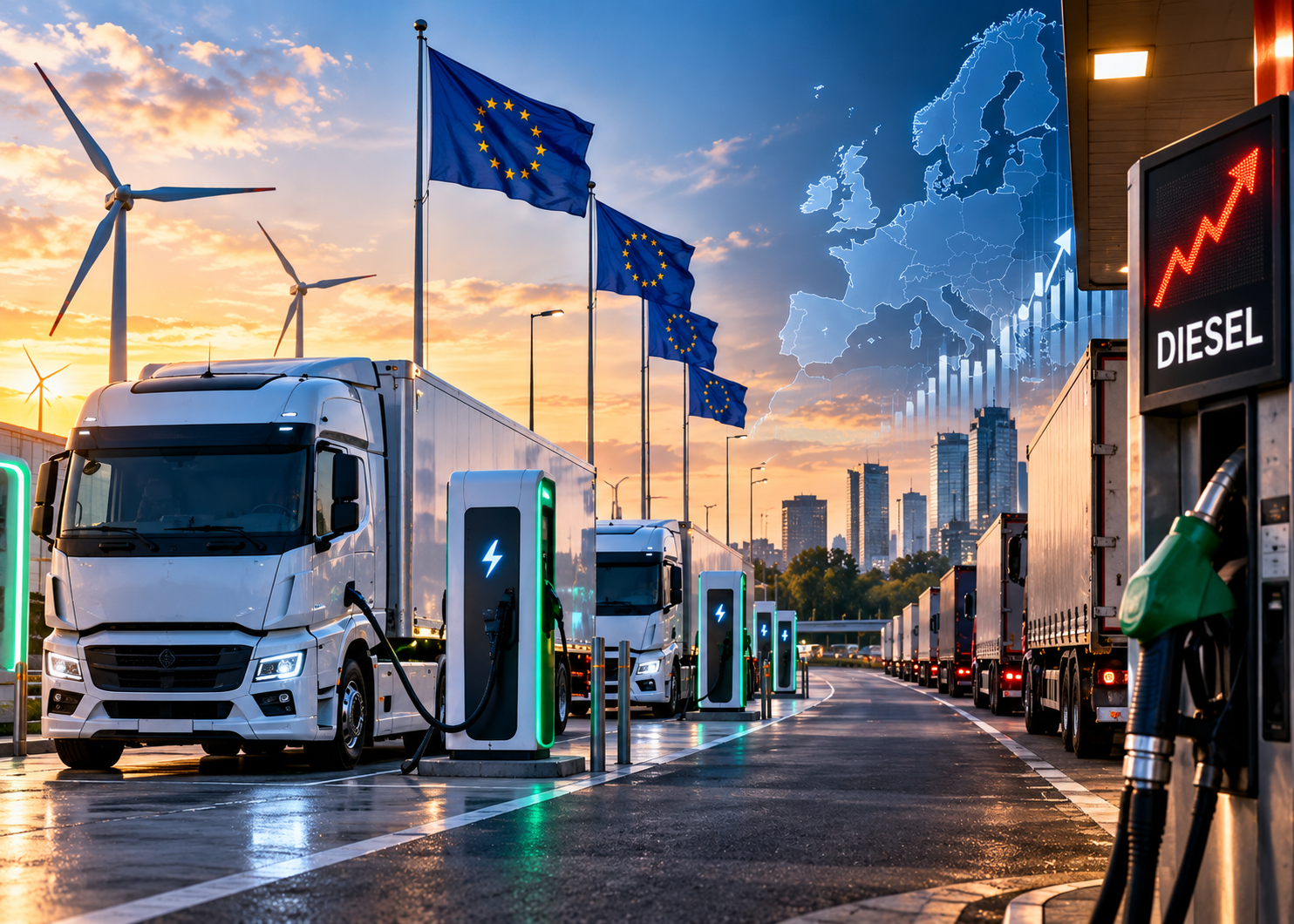
The surge in diesel prices linked to this year’s Iran conflict is changing the economics of Europe’s heavy-truck market, with electric trucks now estimated to cost less to own and operate than diesel models across six major European Union markets.
An analysis from Brussels-based advocacy group Transport & Environment found that electric trucks purchased in 2026 can generate five-year savings of as much as €100,000 in the Netherlands, €85,000 in Germany and €69,000 in Denmark compared with diesel vehicles.
The study examined total ownership costs across nine EU countries.
It concluded that electric trucks are already cheaper to operate in the Netherlands, Germany, Denmark, Sweden, France and Belgium. Those markets collectively account for 46% of new heavy-truck registrations in the European Union.
In several markets, operators can recover the higher initial purchase price of an electric truck in roughly two years, according to the analysis.
The shift matters because high acquisition costs and inadequate charging infrastructure have been two of the biggest barriers to electric heavy-truck adoption.
Higher diesel prices are now changing that calculation.
The competitive picture is becoming more complicated for European manufacturers including Daimler Truck, Volvo and Traton’s Scania. Chinese manufacturers are preparing lower-cost electric trucks for Europe, potentially intensifying pressure on established producers.
Transport & Environment estimated that a Chinese-built electric truck costs approximately €210,000 compared with about €265,000 for a European equivalent. In Germany, its analysis estimated another €34,000 in five-year savings from choosing a Chinese model.
Those estimates come from an advocacy organization rather than an independent market authority, so actual fleet economics will vary with fuel prices, electricity costs, subsidies, financing, mileage and charging availability.
But the broader signal is significant: elevated fossil-fuel prices are narrowing — and in some markets potentially reversing — the cost disadvantage that has slowed commercial-vehicle electrification.
Investors should watch whether sustained diesel prices accelerate fleet orders and whether European governments respond to growing competition from lower-cost Chinese manufacturers.