Alibaba has unveiled a new artificial-intelligence processor and outlined plans for a dramatically larger AI model, intensifying China’s effort to build a domestic computing stack as access to advanced U.S. chips remains constrained.
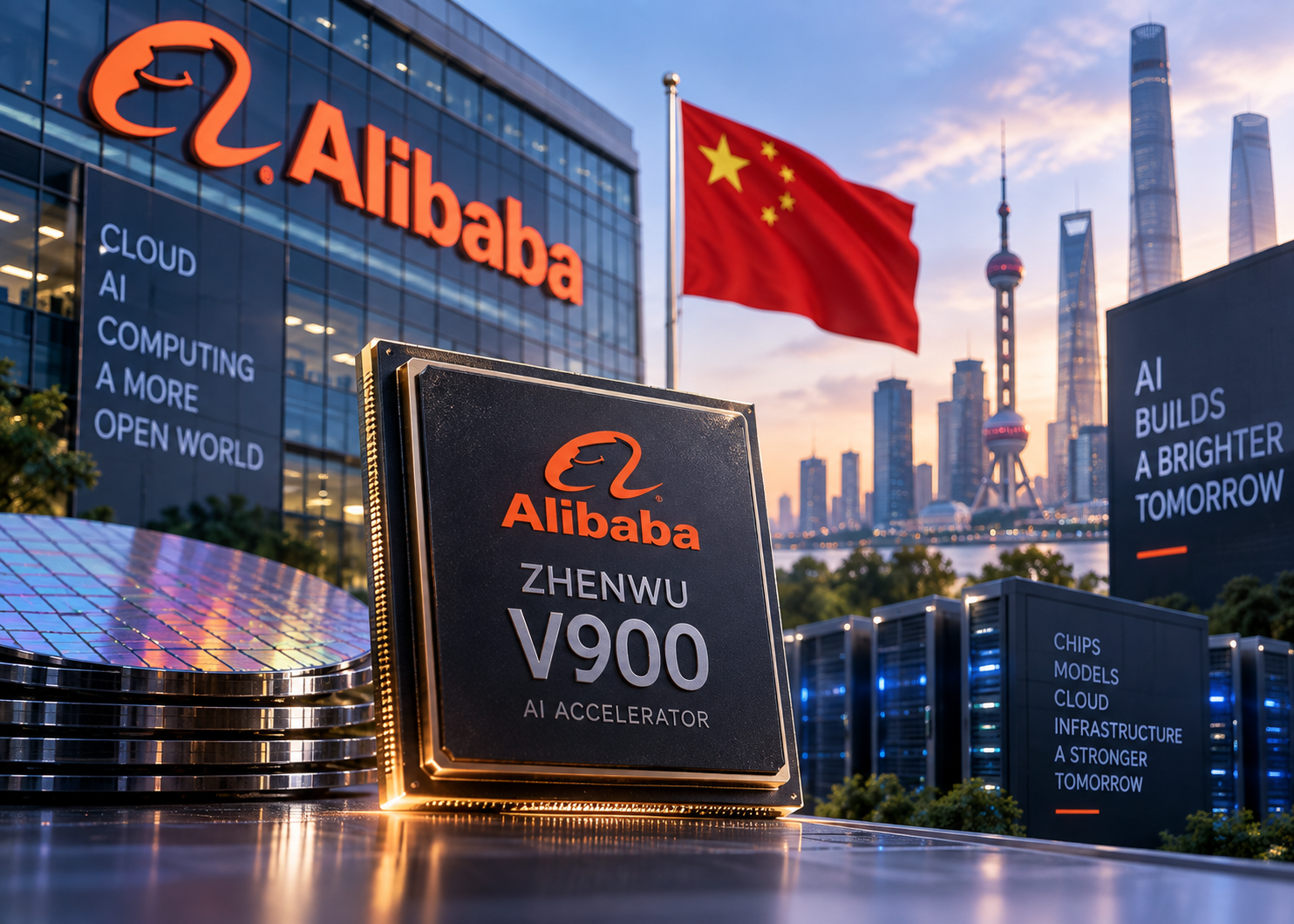
Alibaba introduced its Zhenwu V900 accelerator Tuesday, describing it as its most powerful AI processor in China and saying it delivers roughly three times the performance of its predecessor. Reuters independently reported the announcement from Alibaba’s Apsara conference in Hangzhou.
The company is also planning a new AI model containing between 5 trillion and 10 trillion parameters, compared with roughly 2.4 trillion parameters for its current flagship model cited in reporting on the announcement.
Alibaba’s own cloud documentation already shows production support for Zhenwu parallel-processing hardware inside its Kubernetes infrastructure, providing direct company documentation of the hardware ecosystem supporting the new processor family.
The strategy extends beyond chips and models.
Alibaba said it wants its global cloud data-center capacity to exceed 20 gigawatts by 2032, tying together semiconductor design, AI models and physical infrastructure into a vertically integrated computing platform.
Investors responded quickly. Alibaba’s Hong Kong shares rose about 5% following the announcement, according to Reuters.
The development matters because U.S. export controls have restricted Chinese access to some of the most advanced AI processors.
That has increased the strategic value of domestic alternatives developed by Chinese companies. Alibaba’s push indicates that the competitive battle is expanding beyond individual chips toward complete ecosystems combining processors, cloud infrastructure and proprietary models.
Performance claims still require caution.
Alibaba’s description of the V900 as China’s most powerful AI chip is the company’s characterization. Independent benchmark evidence establishing that ranking across competing Chinese processors was not presented in the source material reviewed for this article.
For markets, the larger issue is whether domestic Chinese accelerators can become capable enough—and available in sufficient volume—to reduce dependence on imported high-end hardware.
If they can, U.S. export restrictions may increasingly influence the structure of the global AI industry by accelerating the development of parallel technology ecosystems rather than simply limiting Chinese computing capacity.