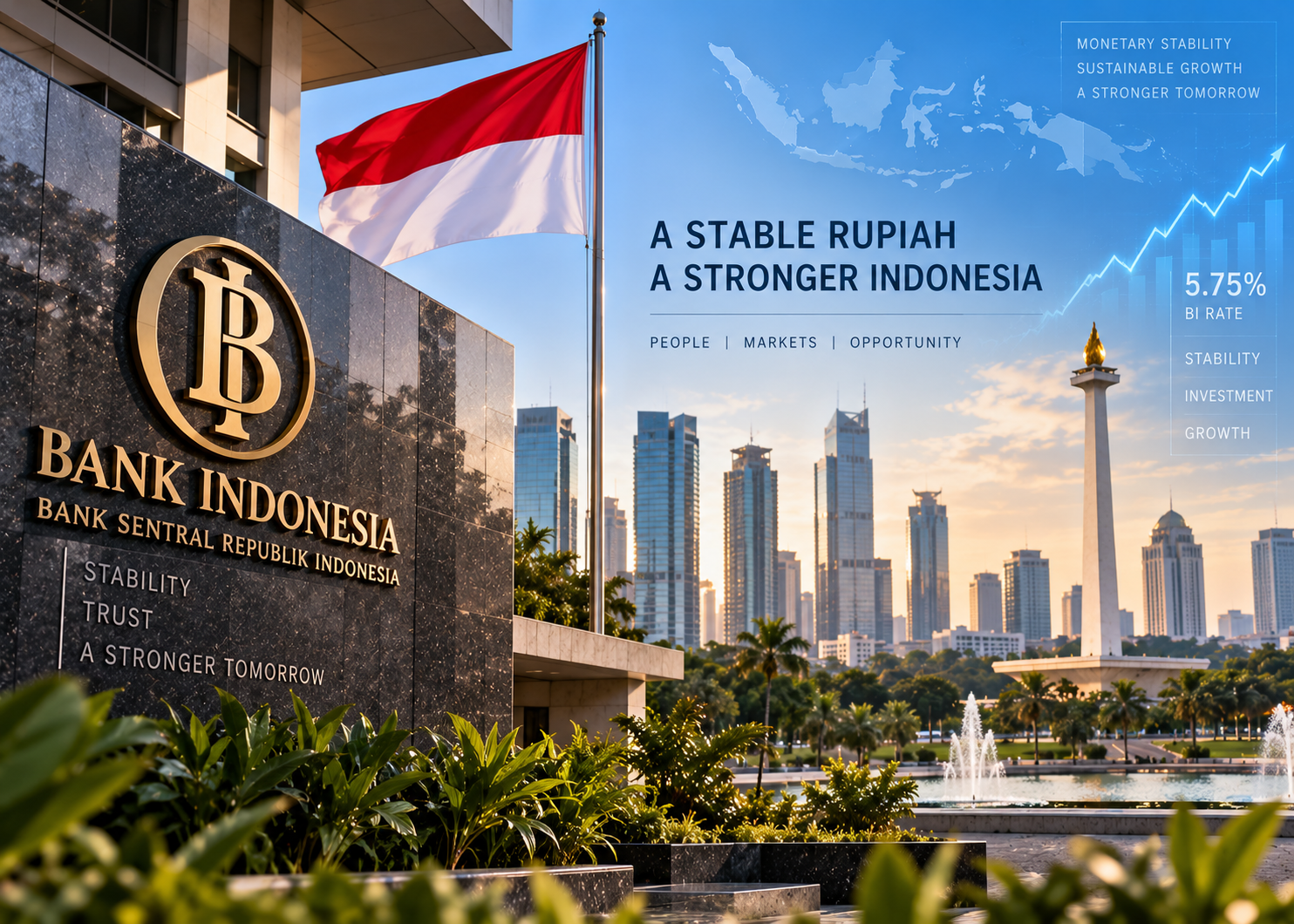
Bank Indonesia left its benchmark interest rate unchanged Wednesday, maintaining a restrictive stance as policymakers balance economic growth against pressure on the rupiah and renewed external volatility.
The central bank held the BI-Rate at 5.75%, the deposit facility rate at 4.75% and the lending facility rate at 6.50% following its September policy meeting.
The decision keeps Indonesian monetary policy restrictive as officials monitor currency conditions, inflation and international capital flows.
Currency stability remains a central concern.
Bank Indonesia has emphasized policies designed to attract foreign capital, support the rupiah and deepen domestic money and foreign-exchange markets.
Those measures allow the central bank to address financial-market pressure through more than its benchmark interest rate alone.
Indonesia faces a difficult external environment in which global interest rates, energy prices and geopolitical uncertainty can affect emerging-market currencies and foreign capital flows.
Holding rates gives policymakers additional time to assess those pressures without imposing another immediate increase in borrowing costs on the domestic economy.
Indonesia’s relatively high interest rates can help support demand for rupiah-denominated assets, but restrictive monetary policy also raises financing costs for households and businesses.
That leaves Bank Indonesia balancing two objectives: maintaining sufficient monetary restraint to support currency and price stability while avoiding unnecessary damage to domestic growth.
For investors, future decisions are likely to depend heavily on the rupiah, inflation and global financial conditions.