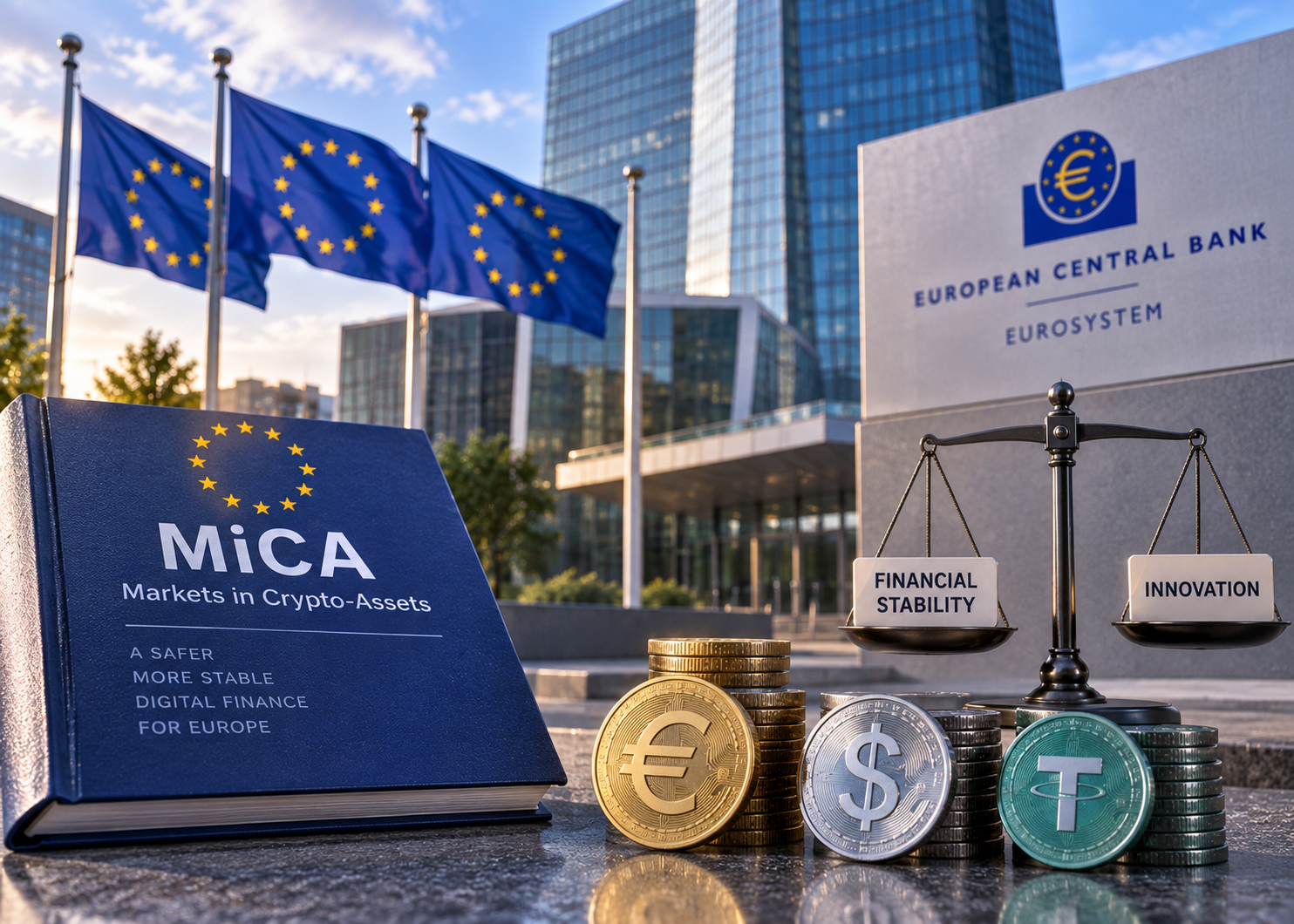
European central banks are seeking a significant change to the European Union’s stablecoin framework, arguing that mandatory bank-deposit requirements could create financial-stability risks rather than reduce them.
The European Central Bank and national central banks in the Eurosystem have recommended removing provisions under the EU’s Markets in Crypto-Assets framework that require stablecoin issuers to hold part of their reserves as bank deposits, Reuters reported Tuesday.
Under the existing framework described by Reuters, issuers generally must maintain at least 30% of relevant reserves in bank deposits, rising to 60% for significant issuers.
Central banks argue that large stablecoin issuers could create unusually concentrated and potentially volatile deposits.
Instead, the proposal would move toward liquidity requirements based on reserve assets capable of maturing within roughly one to five working days, according to Reuters.
The debate reflects a broader concern about how rapidly growing stablecoins interact with conventional banks.
An earlier ECB analysis warned that widespread stablecoin adoption could pull deposits away from commercial banks, increase their funding costs and potentially weaken credit provision. The global stablecoin market was still much smaller than the euro-area deposit system when that analysis was published, but policymakers identified rapid growth as a potential transmission channel into the banking system.
The central banks also remain concerned about so-called multi-issuance structures, where tokens issued inside and outside the European Union could effectively become interchangeable.
That structure could complicate supervision and create redemption obligations extending beyond the reserves held by an EU-regulated entity.
The proposal does not itself rewrite MiCA.
It represents a regulatory recommendation that would require the relevant European legislative process before the existing framework changes.
For markets, the debate shows that stablecoin regulation is entering a more complicated phase.
The original challenge was ensuring that issuers held sufficient high-quality reserves. The emerging question is whether the composition and location of those reserves can themselves create risks for banks and financial markets.
As stablecoins become more integrated with payments and tokenized securities, reserve design may become as important as the tokens themselves.