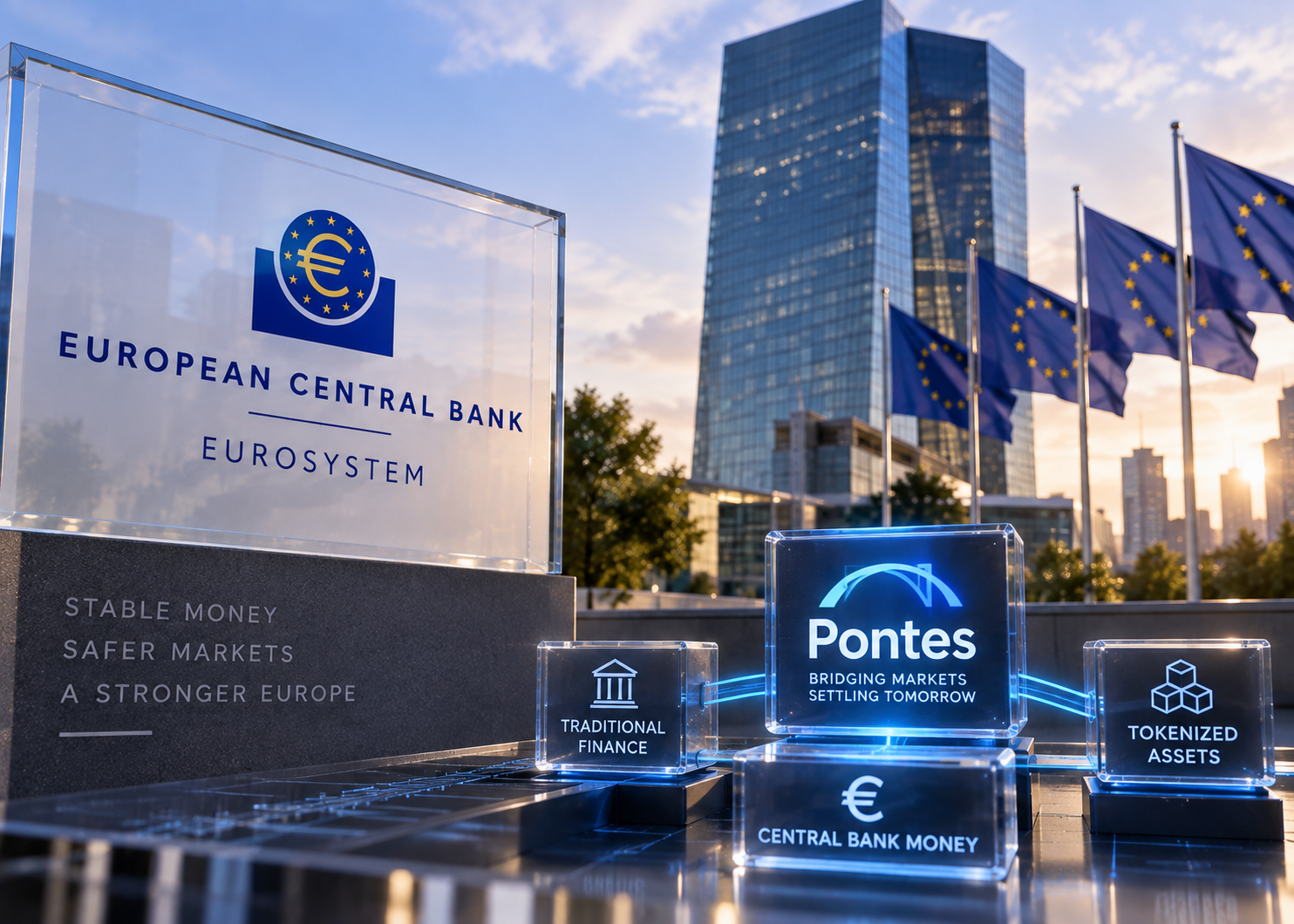
The European Central Bank has opened a new bridge between conventional central-bank infrastructure and blockchain-based financial markets, allowing tokenized asset transactions to settle directly in central-bank money.
The Eurosystem launched Pontes on September 21, describing it as the first operational step in its strategy for tokenized finance. The service allows wholesale transactions involving assets recorded on distributed ledgers to settle using central-bank money rather than relying exclusively on commercial-bank money or private digital tokens.
Reuters reported that an initial group including Deutsche Bank, Santander and Clearstream had completed onboarding and could use the system from launch.
The ECB is also preparing to become a participant.
It said separately that it intends to invest a small portion of its own funds in euro-denominated tokenized securities issued by euro-area governments, public agencies and European supranational institutions. Those transactions would also settle through Pontes. The ECB has not yet specified the size or timing of those investments.
The distinction between Pontes and a digital euro is important.
Pontes is designed for wholesale financial markets—not everyday consumer payments. It is intended to give banks and market infrastructures access to central-bank settlement while using distributed-ledger systems for tokenized securities.
That addresses one of the central questions surrounding institutional tokenization: what form of money ultimately settles the trade.
Private stablecoins can perform that function, but they introduce issuer and reserve risks that central-bank money does not carry.
The ECB says Pontes will expand gradually, with enhanced functionality and longer operating hours expected as the system develops toward full implementation in 2028.
For markets, the launch marks a shift from experimentation to infrastructure.
Europe is no longer simply studying how blockchain could interact with conventional securities markets. It now has an operational mechanism designed to place central-bank money directly underneath tokenized wholesale transactions.