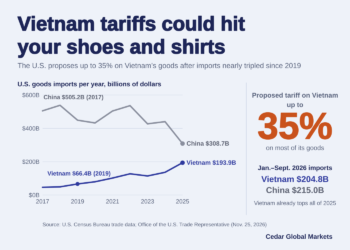
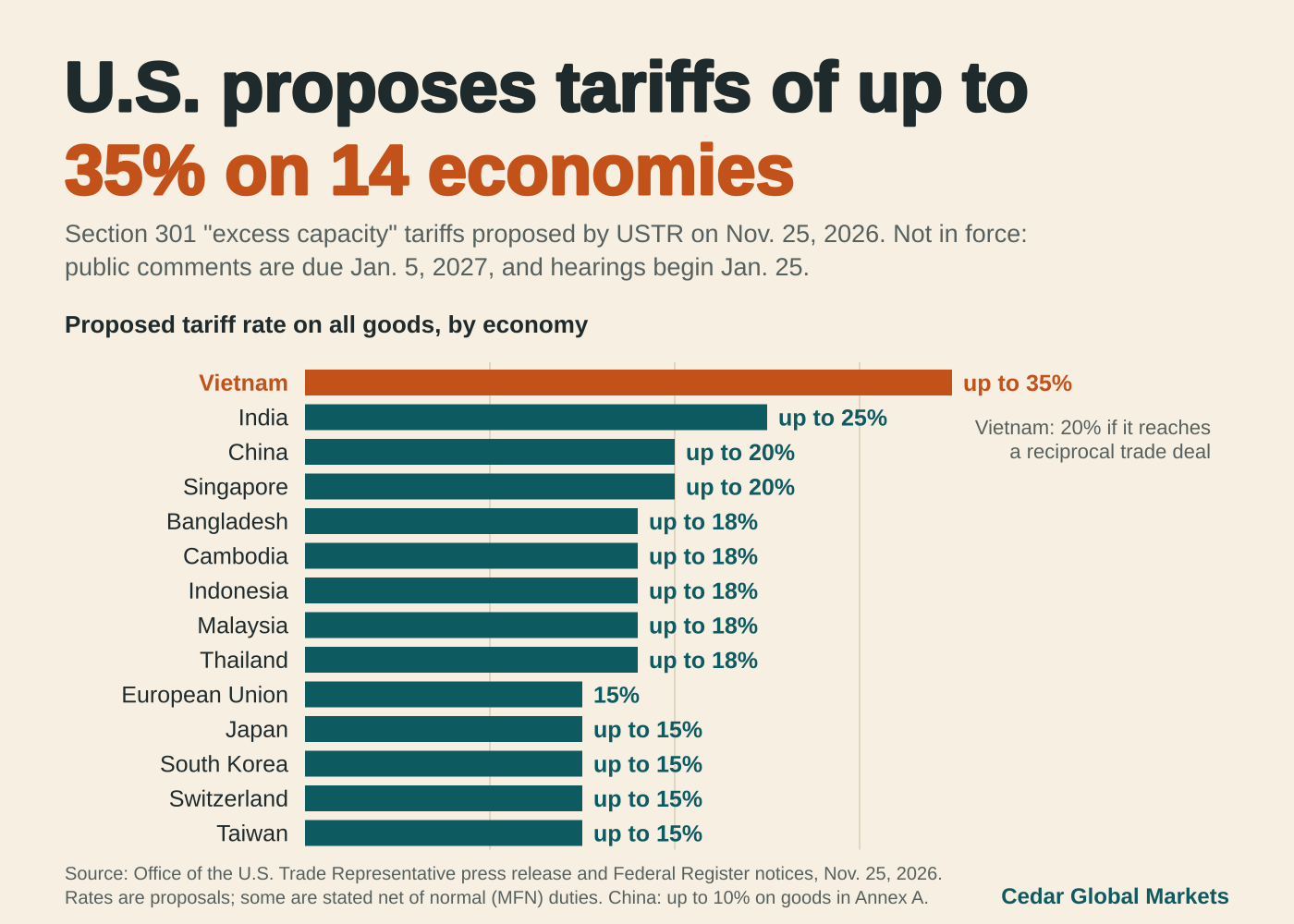
The Section 301 excess capacity investigations have turned into proposed tariffs. On Wednesday, Nov. 25, U.S. Trade Representative Jamieson Greer determined that the industrial policies of 14 economies create structural excess capacity in manufacturing, are unreasonable and burden U.S. commerce, and proposed new tariffs on their goods. The rates are proposals, not duties in force: written comments are due by Jan. 5, 2027, and public hearings begin Jan. 25.
Vietnam faces the highest proposed rate, up to 35 percent on all its goods, though USTR said it would consider 20 percent if Vietnam reaches a reciprocal trade agreement that answers the findings. India faces up to 25 percent, or 17 percent with such a deal. China and Singapore face up to 20 percent, or 10 percent for Singapore with a trade deal, and Bangladesh, Cambodia, Indonesia, Malaysia and Thailand up to 18 percent. The European Union faces 15 percent, and Japan, South Korea, Switzerland and Taiwan up to 15 percent.
For China, USTR proposed up to 20 percent on most goods and up to 10 percent on a list of goods in an annex, with exemptions for products on the U.S.-China Board of Trade’s “30-for-30” list. The agency said the China proposal accounts for the 20 percent rate in the Kuala Lumpur arrangement that President Trump and President Xi Jinping reached on Oct. 30, 2025. It follows months of U.S.-China trade talks in which the two sides extended their trade truce to January. CNN and the law firm Baker McKenzie reported that the notices also set higher alternative rates if USTR finds talks or existing commitments unsatisfactory, up to 40 percent for China and up to 20 percent for the EU.
Each proposal exempts certain goods listed in its notice. For 13 of the 14 economies, goods already under Section 232 tariffs, such as steel, aluminum and cars, would be left out, according to Baker McKenzie, and CNN reported the new duties would not stack on those tariffs.
Greer opened the investigations on March 11 into 16 economies. He made no determination for Mexico or Norway for now. USTR said it heard nearly 140 witnesses and received 1,070 comments. “President Trump is proposing to take action to bring about the elimination of these unfair acts, policies, and practices,” Greer said.
The move gives the administration a new legal route for tariffs after the Supreme Court struck down President Trump’s sweeping global tariffs earlier this year. An administration official told reporters the new duties could take effect in January at the earliest, CNN and Reuters reported.
…
That’s the story. … Thank you for listening to Cedar Global Markets. We’re supported by our partners, and you can learn more about the partner featured on this page. We’ll see you next time.