
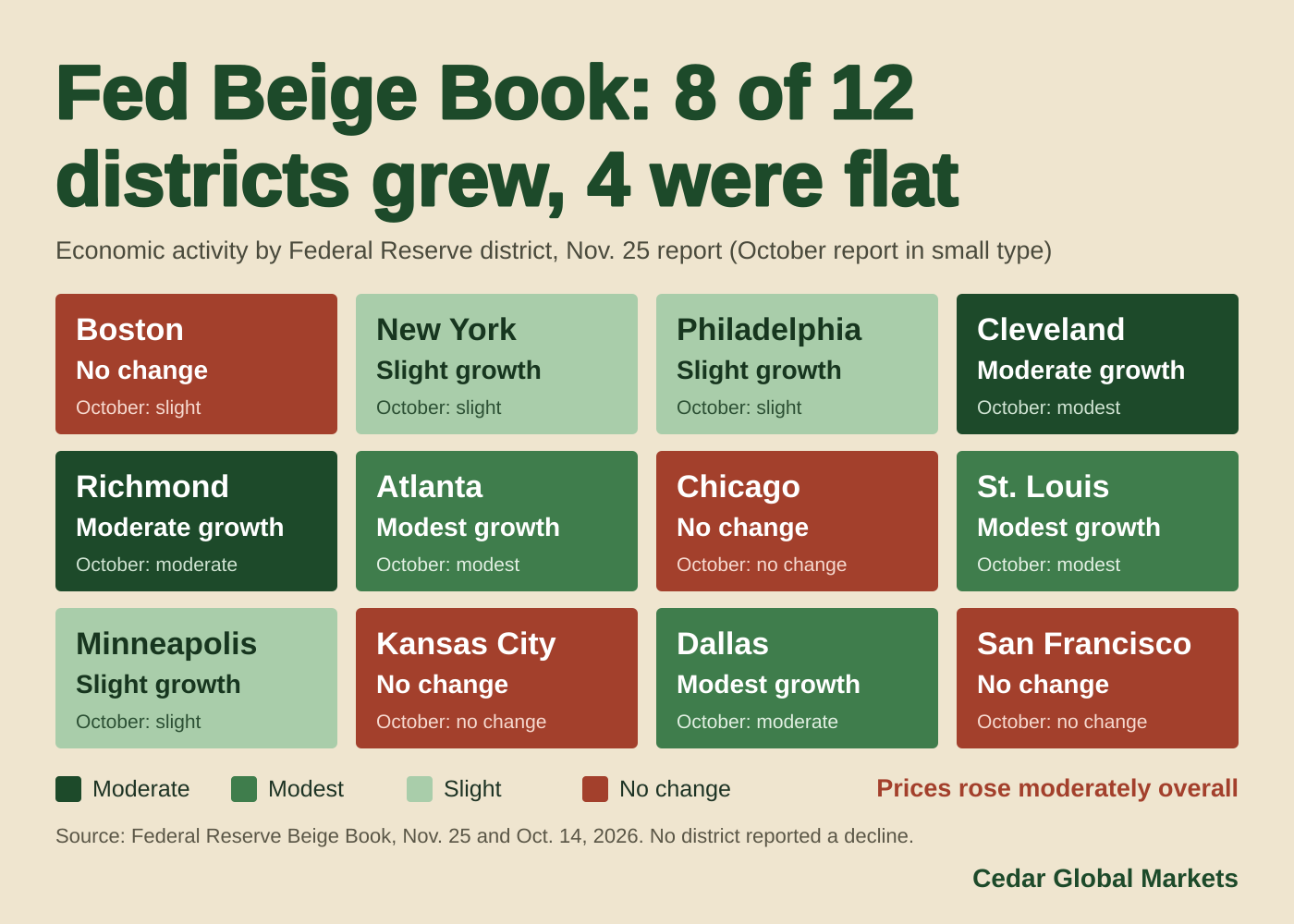
The Fed Beige Book released Wednesday found that eight of the 12 Federal Reserve districts reported economic growth “in the slight to moderate range,” while four reported no change. Prices “increased moderately overall, as in the prior reporting period,” the report said, and business contacts “expected both expenses and prices to continue rising in the coming months.”
Boston, Chicago, Kansas City and San Francisco were the four districts with no change. Cleveland and Richmond reported moderate growth; Atlanta, St. Louis and Dallas reported modest growth; and New York, Philadelphia and Minneapolis reported slight growth. In the October Beige Book, nine districts reported growth and three reported no significant change. Since then, Boston said activity “was roughly unchanged” after slight growth in October, Dallas said its expansion “slowed to a modest pace” from moderate, and Cleveland moved up to moderate growth from modest.
Consumer spending “was little changed, as households remained price sensitive and were increasingly selective in discretionary purchases.” Auto sales softened, which contacts attributed to “elevated fuel prices and higher interest rates.” Residential real estate weakened and construction declined, while manufacturing “grew modestly overall, as robust demand in several industrial segments offset weakness in consumer-facing and housing-related goods.”
Employment “rose slightly on balance,” with many firms “hiring primarily to replace for attrition.” Wages and benefits “rose moderately, an uptick from modest increases in the previous report.”
Firms reported cost pressure from “energy, transportation, healthcare, insurance, and tariff-related expenses.” Input costs generally grew faster than selling prices, as customer price sensitivity “limited firms’ ability to fully pass through higher costs.” St. Louis said prices “have risen at a robust pace,” and Cleveland said selling prices “grew robustly.”
Artificial intelligence and data centers ran through the district reports. Cleveland said some firms were “using AI to limit hiring amid soft demand or to offset rising costs given high inflation.” Kansas City said most firms were training staff to work alongside AI tools and that “the technology has had little impact on employment levels,” while Dallas contacts said AI “thus far had not impacted their head counts.” Atlanta, Cleveland, Chicago and Dallas all cited demand tied to data center construction.
The report, prepared at the Federal Reserve Bank of Atlanta, is based on information collected on or before Nov. 16. It arrived hours after the government’s latest PCE inflation report, and days after Fed Governor Lisa Cook warned that waiting to raise rates has a cost. The Fed’s policy committee next meets Dec. 8-9, a meeting that will include new economic projections.
…
That’s the story. … Thank you for listening to Cedar Global Markets. We’re supported by our partners, and you can learn more about the partner featured on this page. We’ll see you next time.