The Commerce Department on Monday issued a rule meant to stop Chinese companies from getting around U.S. export controls by renting computing power on advanced American AI chips in data centers in other countries.
The department’s Bureau of Industry and Security said the interim final rule, written by and at the direction of the Treasury Department and the National Security Council, is designed to ensure that existing restrictions “cannot be circumvented through remote computing arrangements involving data centers in third countries.”
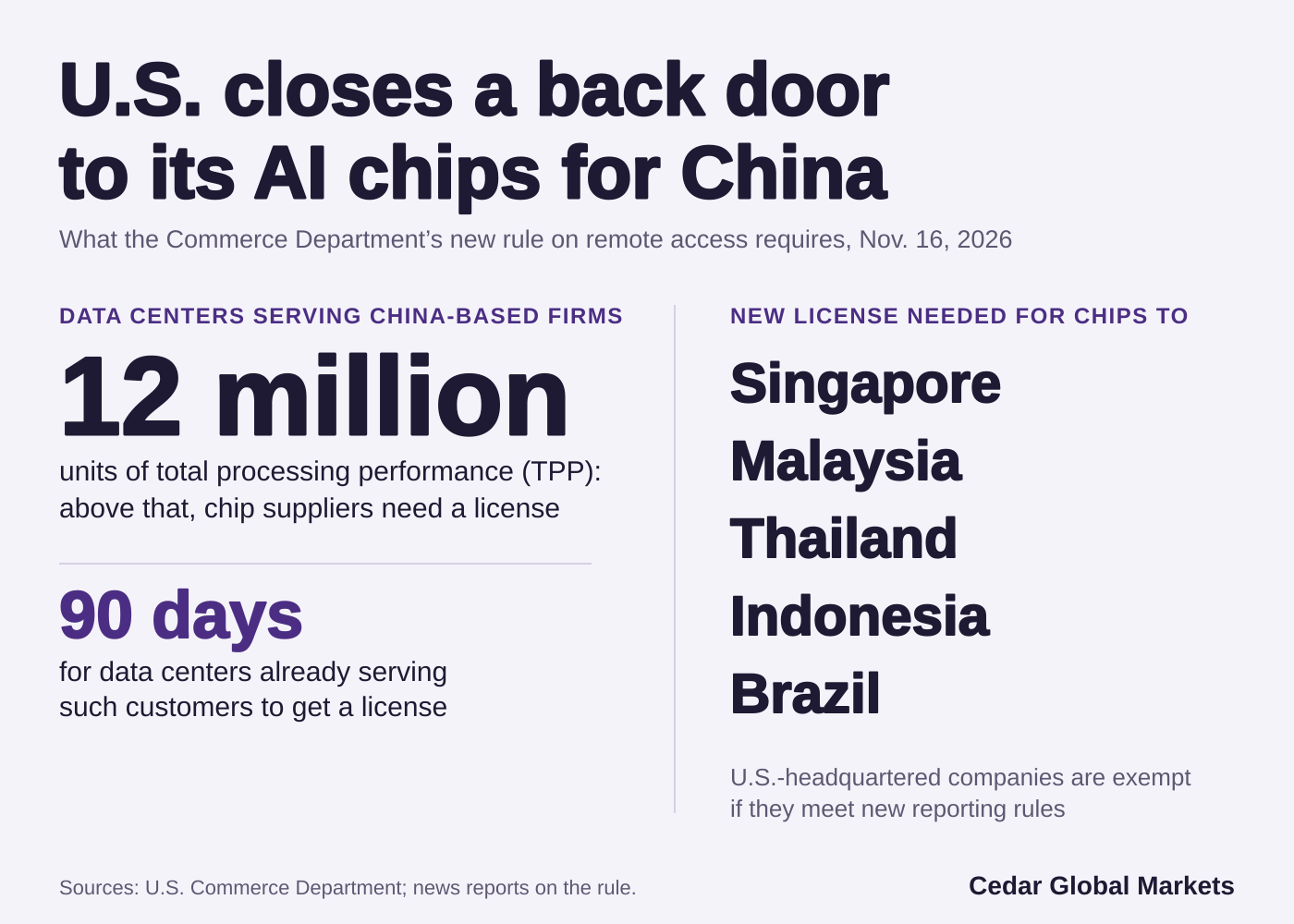
Under the rule, as reported by Techlicious and The Next Web, chip suppliers will need a license to ship to a data center anywhere that provides more than 12 million units of total processing performance (TPP), a measure of computing power, to companies headquartered in China, Macau or other restricted destinations. Data centers already serving such customers will have 90 days after the rule takes effect to get a license.
The rule also requires a license for advanced chips sent to Singapore, Malaysia, Thailand, Indonesia and Brazil, which the department described as countries that “present a higher than normal risk of diversion.” Shipments to companies headquartered in the United States are exempt if they meet new reporting requirements. The public will have 60 days to comment once the rule takes effect.
The rule follows the resignation of Nvidia chief executive Jensen Huang last week. CNBC described it as the first U.S. policy response to the Nvidia scandal and reported that shares of Nvidia, Micron, Intel and AMD fell after it was announced. The department’s announcement did not name Nvidia. Nvidia reports quarterly results on Tuesday.
…
That’s the story. … Thank you for listening to Cedar Global Markets. We’re supported by our partners, and you can learn more about the partner featured on this page. We’ll see you next time.