Federal Reserve Governor Michael Barr said Thursday that the share of U.S. national income going to workers has fallen to a record low, and warned that artificial intelligence could push inequality higher if a few companies capture most of its gains.
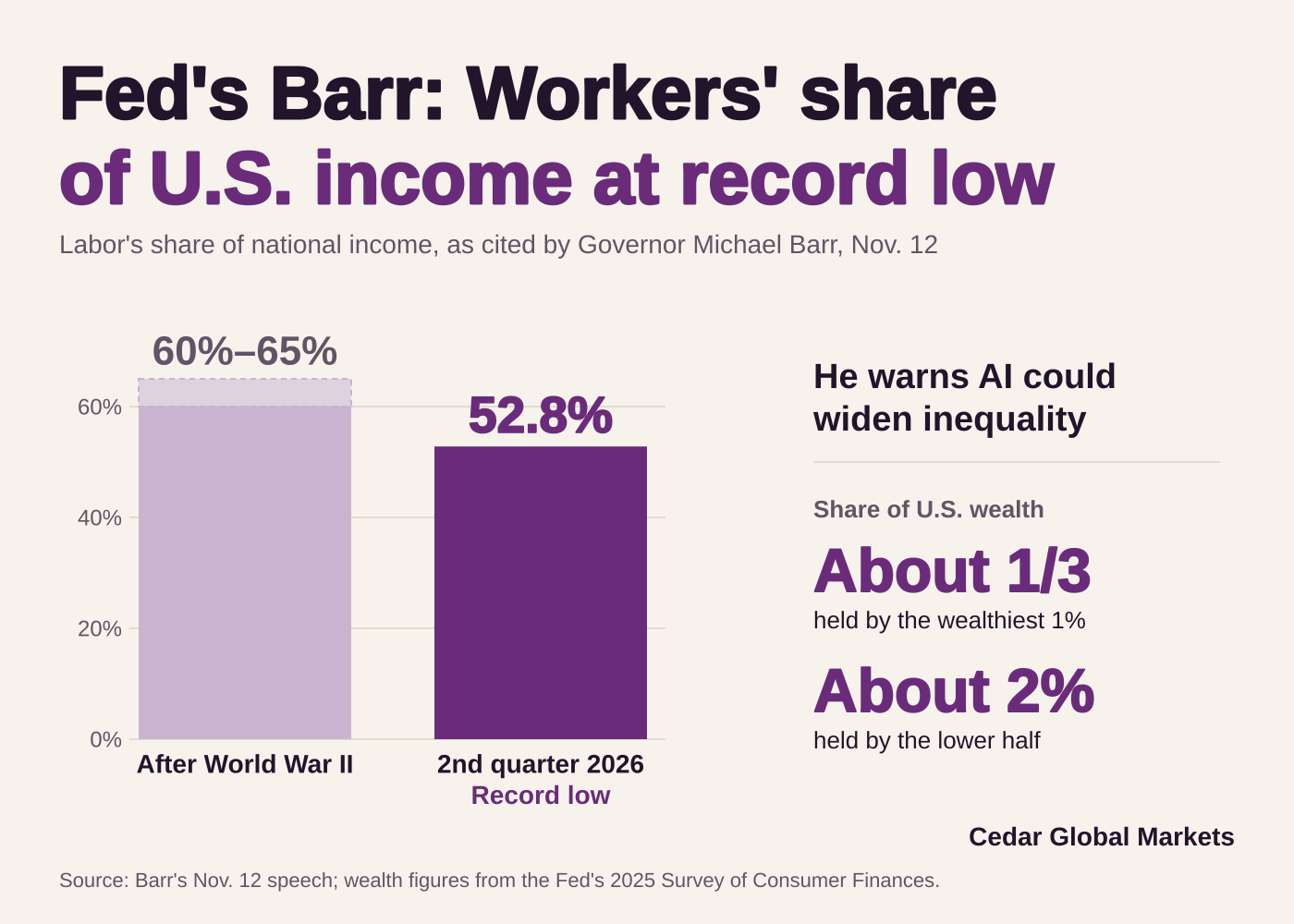
In remarks prepared for delivery at Yale University, Barr said labor’s share of national income held fairly steady between 60% and 65% after World War II, began falling in 2001 and reached a record low of 52.8% in the second quarter of 2026. He said part of the decline reflects how income is measured, but that a clear downward trend remains after adjusting for that.
Citing the Fed’s latest Survey of Consumer Finances, Barr said the wealthiest 1% of households hold about one-third of U.S. wealth, nearly $60 trillion, while the lower half of households hold about 2%.
Barr said AI has so far displaced relatively few workers, but that there are signs it may be substituting for workers in some sectors, especially younger, less-experienced ones. “We should be prepared for the possibility of serious short-term disruptions in the labor market,” he said. If a small number of AI firms dominate, he said, “the labor share of income would decline, market concentration would increase, and inequality would go up.”
Barr did not comment on interest rates in his prepared remarks. He said the views were his own and not necessarily those of other Fed officials.
…
That’s the story. … Thank you for listening to Cedar Global Markets. We’re supported by our partners, and you can learn more about the partner featured on this page. We’ll see you next time.