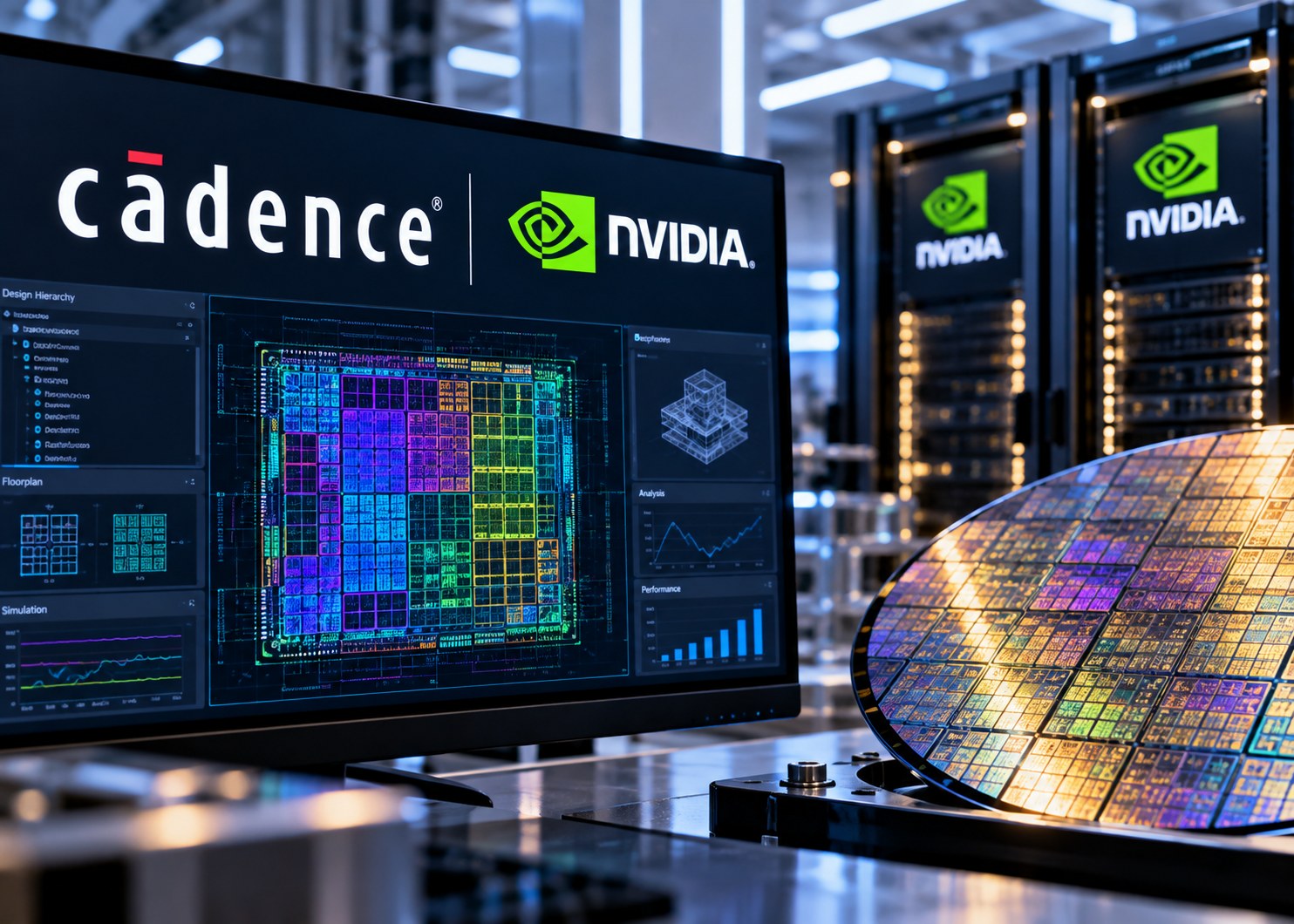
Cadence Design Systems has introduced a new suite of artificial-intelligence models designed specifically for semiconductor engineering, giving chip companies the ability to deploy AI agents while keeping proprietary designs inside company-controlled infrastructure.
The new platform, called Cadence Maestro, was built partly using Nvidia’s open-weight Nemotron technology and incorporates Nvidia’s OpenShell security technology.
Customers can operate the models through Cadence’s cloud, public-cloud infrastructure or entirely within their own data centers and firewalls. Companies can also fine-tune the models using their proprietary chip-design data.
That deployment model addresses one of the most important obstacles to enterprise AI adoption in semiconductor engineering: protecting highly valuable intellectual property.
Cadence says early testing produced improvements of up to 30% in quality and as much as five times better cost efficiency compared with general-purpose models. Those figures are company-reported results rather than independent industry benchmarks.
The launch also intensifies competition with Synopsys, which has pursued its own AI strategy with OpenAI.
The first Maestro models are expected to reach selected early-access customers during the fourth quarter. If specialized AI agents can reliably accelerate chip engineering, electronic-design automation could become another major commercial application for generative AI.
⸻