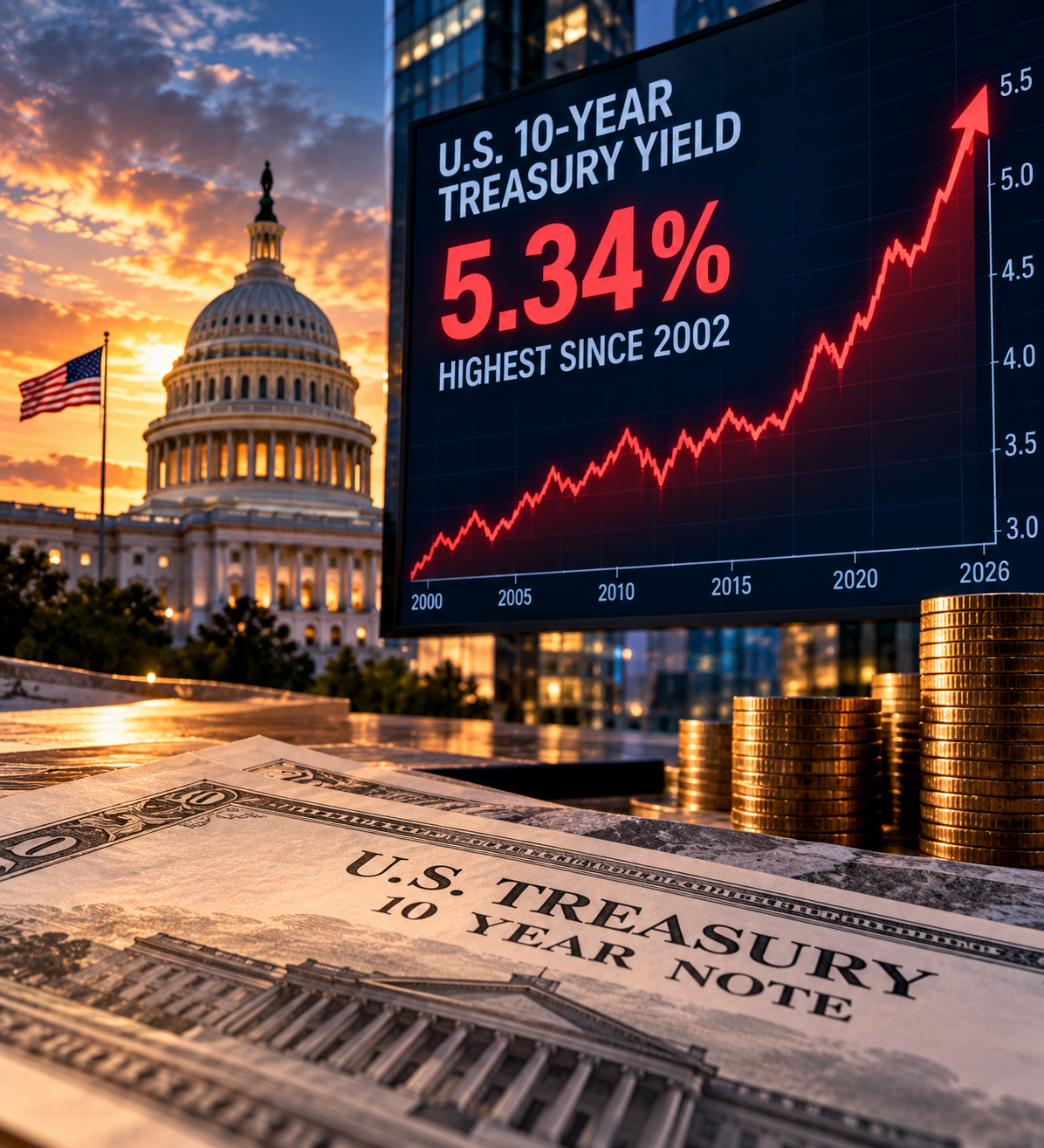
A renewed global bond selloff pushed the benchmark U.S. 10-year Treasury yield to its highest level in 24 years Thursday, intensifying pressure on financial markets as investors confront persistent inflation, expensive energy and expectations that interest rates could remain elevated.
The 10-year Treasury yield climbed to approximately 5.34%, its highest level since 2002. The move followed the Treasury market’s worst quarter since 1994 and the largest quarterly increase in the 10-year yield this century.
The selloff extends well beyond the United States.
France’s 10-year government-bond yield briefly climbed to 4.96%, approaching 5% and its highest level since 2002. Britain’s 30-year yield moved above 6%, reaching its highest level since 1998, while Japanese government borrowing costs continued a historic multiquarter rise.
The synchronized move matters because sovereign yields form the foundation for borrowing costs across the global economy.
Higher government yields increase financing costs for corporations, mortgages and other forms of credit while making bonds more competitive with equities for investor capital.
The pressure has begun spilling into stocks. Europe’s STOXX 600 fell to its lowest level since June during Thursday’s session, although U.S. equity futures remained positive before the opening bell.
At 7:38 a.m. ET, Dow futures were up 0.08%, S&P 500 futures gained 0.23% and Nasdaq-100 futures advanced 0.54%. The Cboe Volatility Index rose to a two-week high of 16.31.
Artificial-intelligence enthusiasm continues to provide a counterweight. Chip and technology shares were higher in premarket trading, helping U.S. equities resist some of the pressure coming from bonds.
But the underlying rate environment is becoming increasingly difficult for risk assets.
Energy costs remain elevated, keeping inflation concerns alive, while massive investment in AI infrastructure is reinforcing expectations for strong capital demand and potentially higher equilibrium interest rates.
Markets are also recalibrating the Federal Reserve outlook.
Wednesday’s softer-than-expected PCE inflation report reduced expectations for an immediate October rate increase, but the broader global bond market is signaling that investors remain concerned about inflation and the longer-term cost of money.
The next test will be whether rising yields begin producing broader stress in equities, credit and the real economy.
For Wall Street, 5.34% on the 10-year Treasury represents more than another incremental increase in rates. It places one of the world’s most important financial benchmarks at a level not seen since 2002 and raises the hurdle that stocks, businesses and borrowers must overcome.