
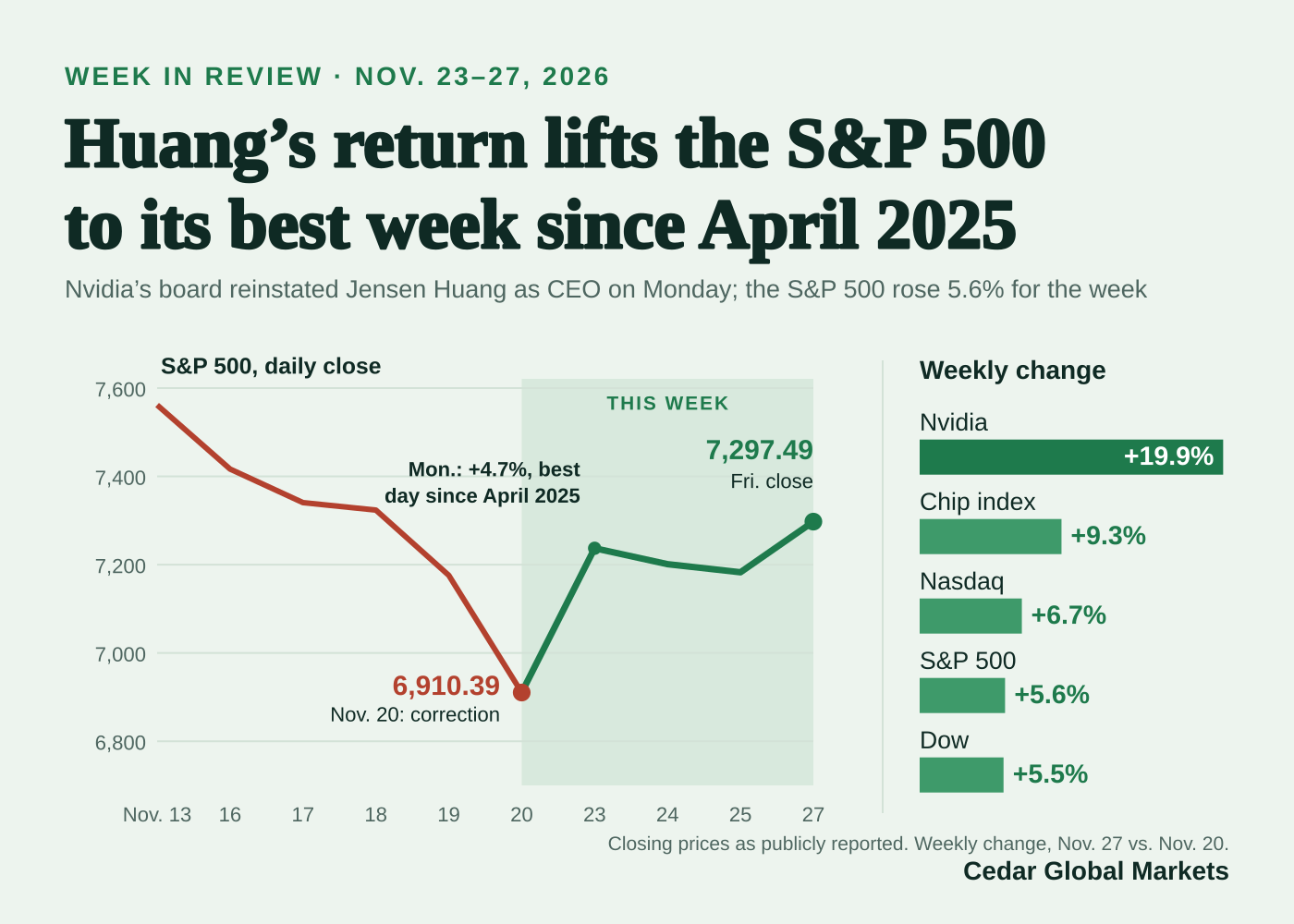
Jensen Huang’s return to Nvidia set off the stock market’s best week since April 2025. The S&P 500 rose 5.6% in the holiday-shortened week, closing Friday at 7,297.49, up from 6,910.39 a week earlier, when it ended in a correction after its worst week since April 2025.
The Nasdaq Composite gained 6.7% to 24,129.50, and the Dow Jones Industrial Average rose 5.5% to 50,774.94, after closing back above 50,000 on Tuesday for the first time since Nov. 18. The Russell 2000 index of smaller companies rose 6.5%. U.S. markets were closed Thursday for Thanksgiving and closed early on Friday.
Nvidia’s board reinstated Huang as chief executive on Monday, less than two weeks after he resigned. The shares jumped 31.5% that day to $165.05, their best day since May 2003, and the S&P 500 rose 4.7%, its best day since April 2025, ending a seven-day losing streak. The PHLX Semiconductor Index surged 14%. Nvidia gave back part of the gain later in the week and closed Friday at $150.49, up 19.9% for the week.
The chip rally did not hold in a straight line. The semiconductor index fell 7.9% on Tuesday. On Wednesday the Nasdaq 100 briefly fell 20% below its October record, the common definition of a bear market, before recovering to close down 0.6%. Anthropic, which went public the week before at $83 a share, closed below its IPO price on Tuesday and Wednesday, then rose to $91.88 on Friday. On Black Friday chip stocks led a broad rally, and 485 of the 503 stocks in the S&P 500 finished the week higher.
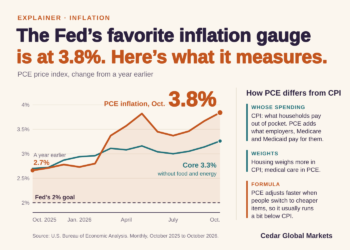
Inflation data pointed the other way. The Fed’s preferred gauge, the PCE price index, rose 3.8% in October from a year earlier, and the core rate rose to 3.3%, the highest since November 2023. Third-quarter growth was revised up to a 4.3% annual rate from 3.4%. The Fed’s Beige Book said eight of its 12 districts grew and prices kept rising. Traders have almost fully priced in a quarter-point Fed rate increase at the Dec. 9 decision, Reuters reported. Fed officials enter their quiet period on Saturday ahead of the Dec. 8-9 meeting.
Two big deals came on Monday and Tuesday. CrowdStrike agreed to buy Zscaler in an all-stock deal valued at about $43.9 billion, and Sanofi agreed to buy lung-drug maker Insmed for $175 a share, about $41 billion. Zscaler rose 22.9% for the week and CrowdStrike fell 5.3%.
On trade, the U.S. Trade Representative on Wednesday proposed new tariffs on 14 economies, up to 35% for Vietnam and a combined rate of up to 20% on most Chinese goods, or up to 40% if talks with Beijing fail. They are proposals, not duties in force, and public comments are due by Jan. 5.
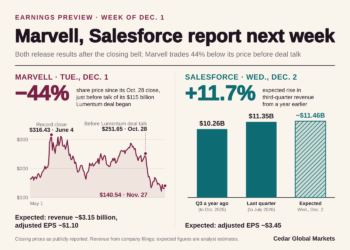
Among S&P 500 stocks, Axon Enterprise rose 24.8%, Palantir Technologies 20.0%, Nvidia 19.9% and Qualcomm 19.6%. HP Inc. gained 15.0% after its adjusted quarterly profit topped its own forecast. West Pharmaceutical Services fell 6.2%, the biggest decline in the index, followed by CrowdStrike, down 5.3%, and J.M. Smucker, down 5.1%. Dell rose 14.0% for the week; on Tuesday it reported that its quarterly revenue more than doubled.
Bonds moved little over the week. The 10-year Treasury yield ended at 4.94%, from 4.92% a week earlier, after falling to 4.85% on Wednesday, according to the Treasury Department. The Cboe Volatility Index fell to 23.81 from 35.89. Gold futures rose 3.5% to $3,639.60 an ounce. Brent crude rose 3.1% for the week to $95.44 a barrel amid attacks on Saudi oil sites, including a projectile that hit the Jazan refinery on Thursday, and OPEC+ countries meet on Sunday. Bitcoin stayed near $60,000 and is down more than 22% in November.
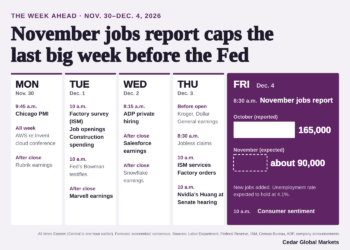
The rebound still leaves November in the red. With one trading day left, on Monday, the S&P 500 is down 3.7% for the month and the Nasdaq is down 5.1%, on track for their worst November since 2008, Reuters reported. Next week brings the November jobs report on Friday, Dec. 4.
…
That’s the story. … Thank you for listening to Cedar Global Markets. We’re supported by our partners, and you can learn more about the partner featured on this page. We’ll see you next time.