
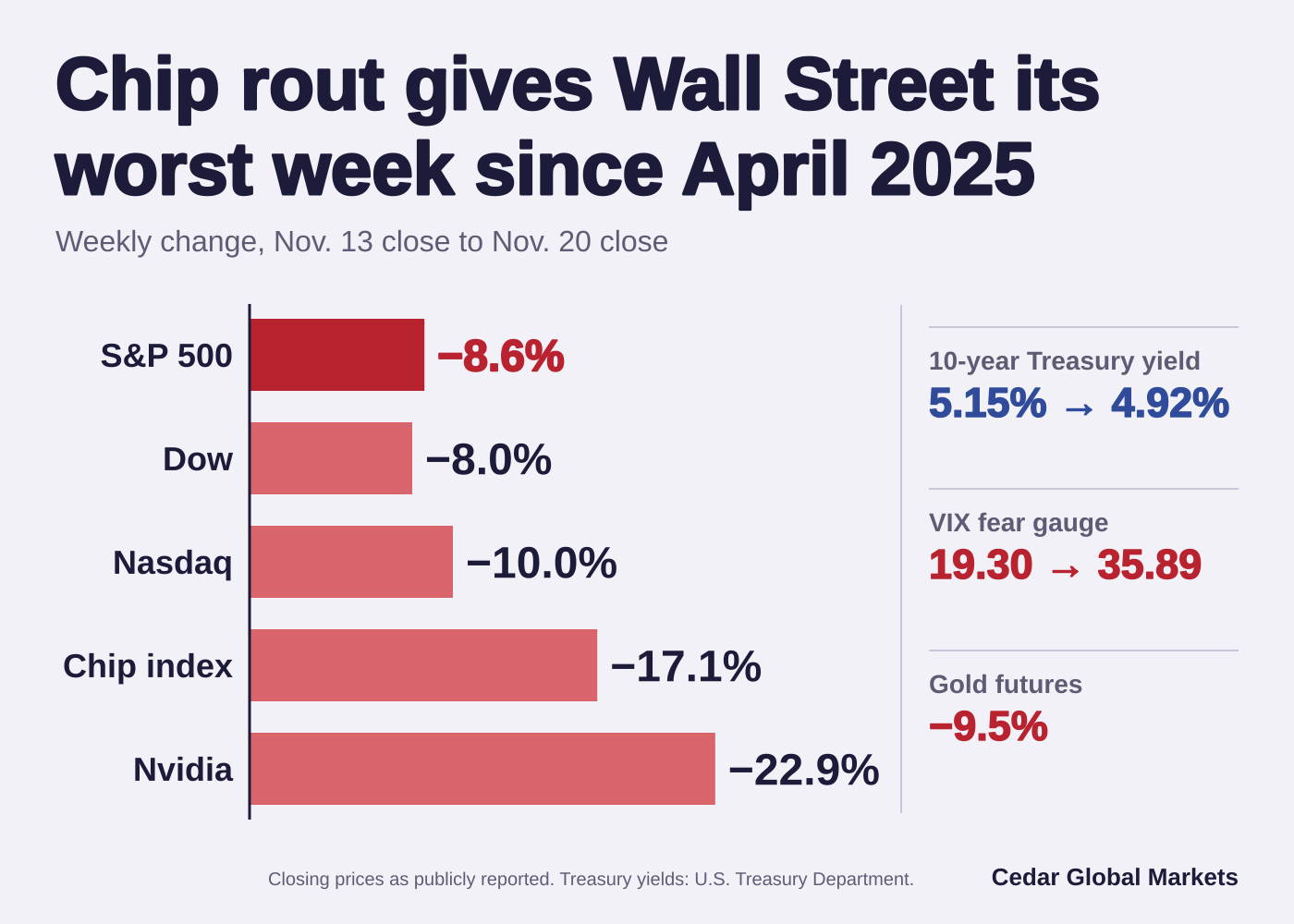
A sell-off in chip and artificial intelligence stocks took over Wall Street this week. The S&P 500 fell on all five days and closed Friday at 6,910.39, down 8.6% from 7,561.67 a week earlier, its worst week since the week ended April 4, 2025. It was the index’s seventh straight daily loss, and it left the S&P 500 11.6% below its record close of 7,818.93 on Oct. 6, past the 10% drop that marks a correction.
The Nasdaq Composite lost 10.0% to 22,617.73, from 25,136.27, matching its drop in the week ended April 4, 2025, and is now down 2.7% for 2026. The Dow Jones Industrial Average fell 8.0% to 48,147.33, from 52,347.55, its worst week since March 2020. The Dow is also in a correction, 11.4% below its Aug. 5 record. The PHLX Semiconductor Index fell 17.1% for the week, including 10.7% on Friday alone.
Nvidia was at the center of it. On Tuesday the chipmaker said its revenue more than doubled to $115.8 billion in its first results since Jensen Huang resigned as chief executive, and its board said it does not intend to reinstate him. The shares rose after hours but fell 2.9% on Wednesday. On Friday they plunged 14% to $125.53, their biggest one-day drop since Jan. 27, 2025, after Reuters reported that Securities and Exchange Commission enforcement staff are examining Nvidia’s accounting. The SEC declined to comment to Reuters, and an investigation does not mean a company has done anything wrong. Nvidia fell 22.9% for the week.
Anthropic, the developer of the Claude AI models, had the week’s biggest stock market debut. It priced its initial public offering at $83 a share on Wednesday, above its $70 to $78 range, raising about $81.3 billion. The shares opened Thursday at $111.50, 34% above the offering price, then slid as the wider market turned lower. They closed at $97.17 on Thursday and $88.91 on Friday, 7.1% above the IPO price. The Dow dropped 1,101 points on Thursday.
The Federal Reserve kept talking about higher rates. Minutes of the Fed’s October meeting, released Wednesday, said “almost all participants” judged that further rate increases would likely be appropriate, and that a couple raised the idea of a move larger than a quarter point at the next meeting if inflation data were unfavorable. Governor Christopher Waller said in a CNBC interview on Wednesday that the Fed should consider a half-point increase, according to Bloomberg. On Friday, Governor Lisa Cook said, “Waiting to act when a policy adjustment is required has a cost.” On Monday, Fed Chair Kevin Warsh described several ways AI could shape the economy, including one in which the boom disappoints and stock valuations fall. The Fed’s target range is 3.75% to 4%, and its next meeting is Dec. 8 and 9.
Investors still moved into government bonds as stocks fell. The 10-year Treasury yield ended the week at 4.92%, down from 5.15%, and the two-year yield fell to 4.63% from 4.88%, according to the Treasury Department. The Cboe Volatility Index, Wall Street’s fear gauge, closed Friday at 35.89, its highest close since April 2025, up from 19.30 a week earlier.
Other assets fell too. Gold futures settled Friday at $3,515.40 an ounce, down 9.5% for the week, their worst week since March, and silver futures fell 16.3%. Bitcoin fell below $60,000 on Friday for the first time since July and was trading near $60,000 on Saturday.
Health insurers had their own sell-off. On Monday, the Centers for Medicare & Medicaid Services proposed a broad anti-fraud rule that includes tougher audits of private Medicare Advantage plans. UnitedHealth Group fell 16.6% for the week and Humana 13.3%, even after both rose on Friday when TD Cowen upgraded them.
The S&P 500’s biggest losers were Sandisk, down 28.4%, Bloom Energy, down 25.8%, and Micron Technology, down 23.6%, with Nvidia close behind. The top gainers were Tyson Foods, up 10.7% after its year-end report on Monday, which included a dividend increase, Hormel Foods, up 6.6%, and Palo Alto Networks, up 6.5% after it raised its full-year forecast. After the closing bell on Friday, Zscaler jumped about 16% on a Bloomberg News report that CrowdStrike is in talks to buy it.
Economic data were mixed. Retail sales rose just 0.2% in October, industrial production fell 0.4%, and pending home sales fell 4.7% to a record low. Weekly jobless claims edged up to 203,000. On Friday, the University of Michigan said Americans’ year-ahead inflation expectations fell to 3.7% from 4.7% in October, while its consumer sentiment index rose to 51.5.
Next week is a short one: U.S. stock markets are closed on Thursday for Thanksgiving and close early on Friday.
…
That’s the story. … Thank you for listening to Cedar Global Markets. We’re supported by our partners, and you can learn more about the partner featured on this page. We’ll see you next time.