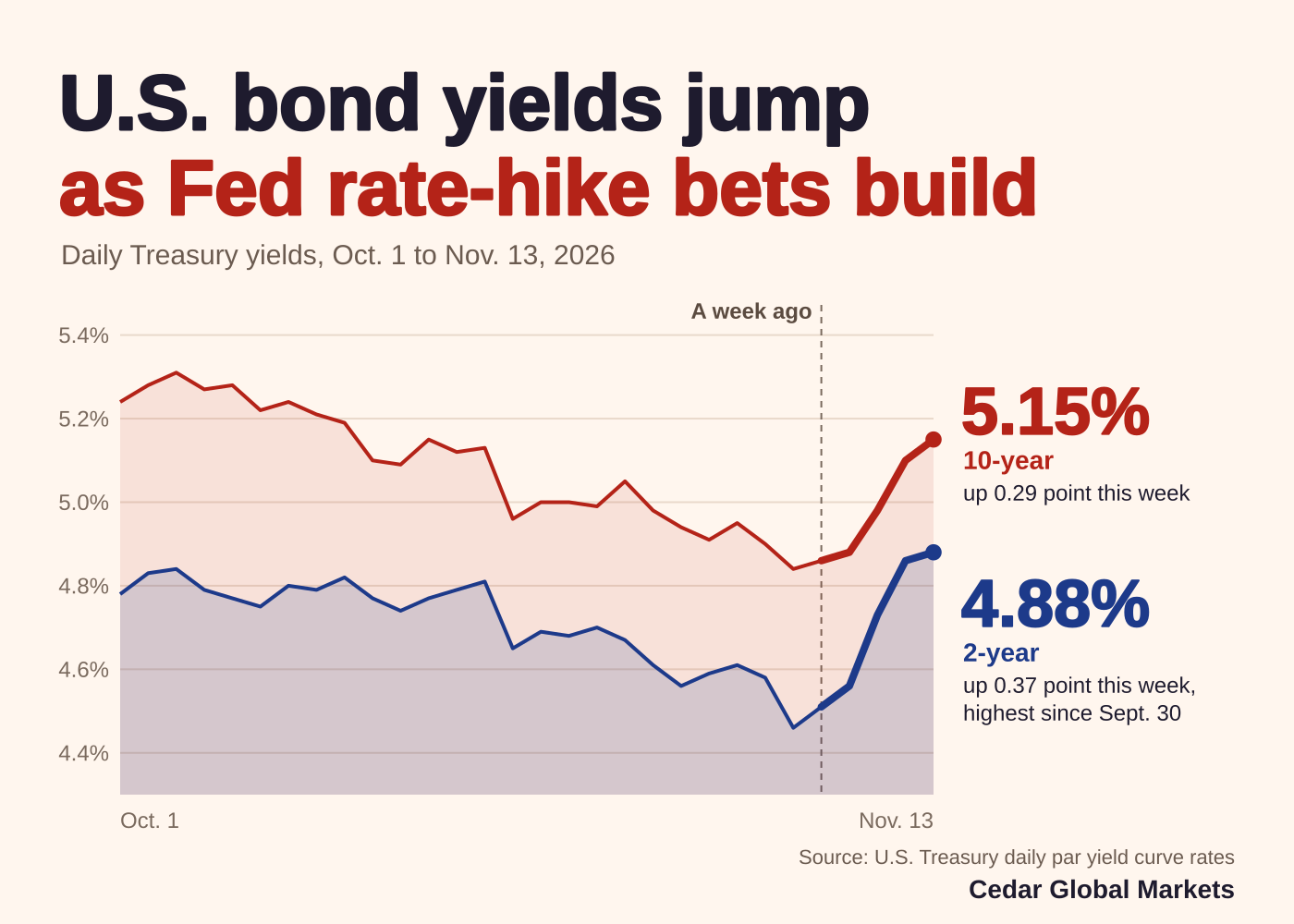
U.S. government borrowing costs climbed sharply this week. The yield on the 10-year Treasury note ended Friday at 5.15%, up from 4.86% a week earlier, according to the Treasury Department’s daily yield curve. That matched its Oct. 19 level and was its highest close since mid-October.
The bigger move came in shorter-term bonds. The two-year yield, which most closely tracks expectations for Federal Reserve policy, rose to 4.88% from 4.51%, a jump of 0.37 percentage point in one week and its highest close since Sept. 30. The 30-year yield rose to 5.47% from 5.26%.
The climb followed a run of hot inflation news. Consumer prices for October came in hotter than expected on Tuesday, and on Friday the Labor Department said wholesale prices were up 6.5% from a year earlier, the highest annual rate since 2022. Fed Governor Christopher Waller said Tuesday he was leaning toward supporting a quarter-point rate increase at the Fed’s December meeting, and that a half-point hike should be considered if core consumer prices rose around 0.3% or more in October. They rose 0.3%.
After Tuesday’s inflation report, CME Group’s FedWatch tool showed markets pricing an 88.8% chance of a quarter-point hike in December and an 11.2% chance of a half-point hike, according to Investing.com. The Associated Press reported Friday that economists overwhelmingly expect a December increase, with another likely in January.
The 10-year yield helps set U.S. mortgage rates, so the rise matters for home buyers. Stocks held up despite the bond selloff: the S&P 500 fell 0.4% on Friday but gained 2.5% for the week.
…
That’s the story. … Thank you for listening to Cedar Global Markets. We’re supported by our partners, and you can learn more about the partner featured on this page. We’ll see you next time.