
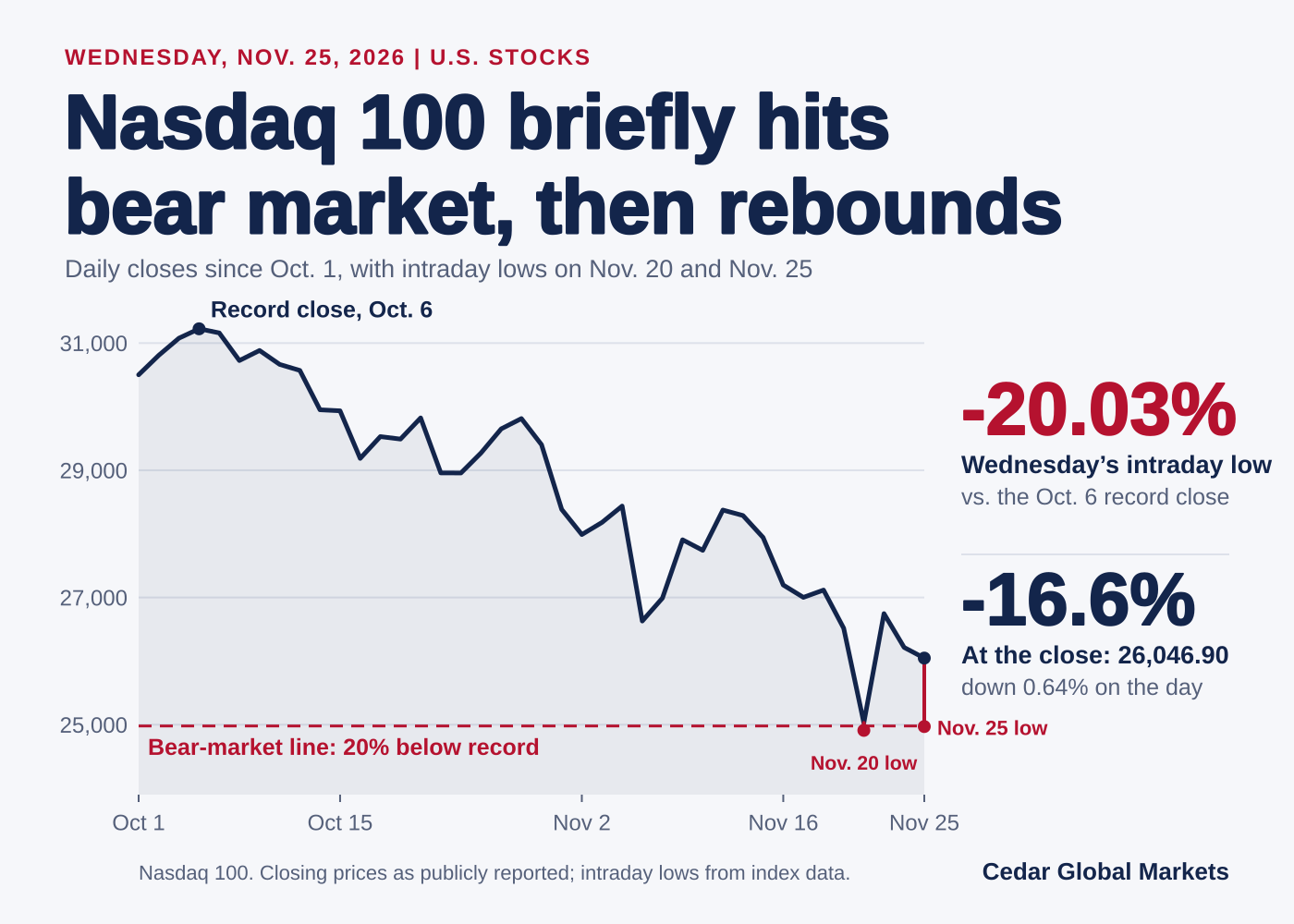
The Nasdaq 100 crossed the bear market line for part of Wednesday’s session, then climbed back above it by the close. The index of the largest companies listed on the Nasdaq fell as low as 24,970.66, 20.03% below its Oct. 6 record close. A bear market is commonly defined as a drop of 20% or more from a peak. A late rebound lifted the index to 26,046.90 at the close, down 0.64% on the day and 16.6% below the record.
It was the second time in four trading sessions that the index sank past that line during the day. On Friday, Nov. 20, it fell as low as 24,910.48 before closing 19.8% below its record, the day the S&P 500 ended its worst week since April 2025 in a correction. Neither day ended in bear market territory. The Nasdaq 100 has lost 8.2% so far in November, from 28,384.85 at the end of October.
The rest of the market also closed well off its lows. The S&P 500, which had clawed back most of a steep morning drop by early afternoon, ended at 7,182.78, down 0.25%. The Nasdaq Composite closed at 23,585.80, down 0.62%. The Dow Jones Industrial Average erased a loss of more than 1% and finished up 164 points, or 0.33%, at 50,182.95.
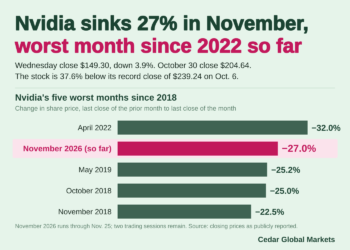
Chip stocks led the swings. Nvidia closed at $149.30, down 3.9% from Tuesday’s close of $155.38, after a much deeper drop earlier in the day.
NBC News reported that markets faced “a rare combination of new inflation data, a tariff announcement from the White House and lingering concerns about the strength of the AI economy.” The Fed’s preferred inflation gauge rose to 3.8% in October, and the administration proposed new tariffs on 14 trading partners. Yahoo Finance said tech stocks sold off amid concerns about higher financing costs and profitability.
U.S. stock markets are closed Thursday for Thanksgiving and close early, at 1 p.m. ET, on Friday.
…
That’s the story. … Thank you for listening to Cedar Global Markets. We’re supported by our partners, and you can learn more about the partner featured on this page. We’ll see you next time.