
Holiday shopping season has barely started, and the retail earnings reports that landed on Tuesday already tell a clear story about the American household budget. Shoppers are living in two economies at once: one where every dollar on the basics is fought over, and one where they will still pay up for the few things they really want.
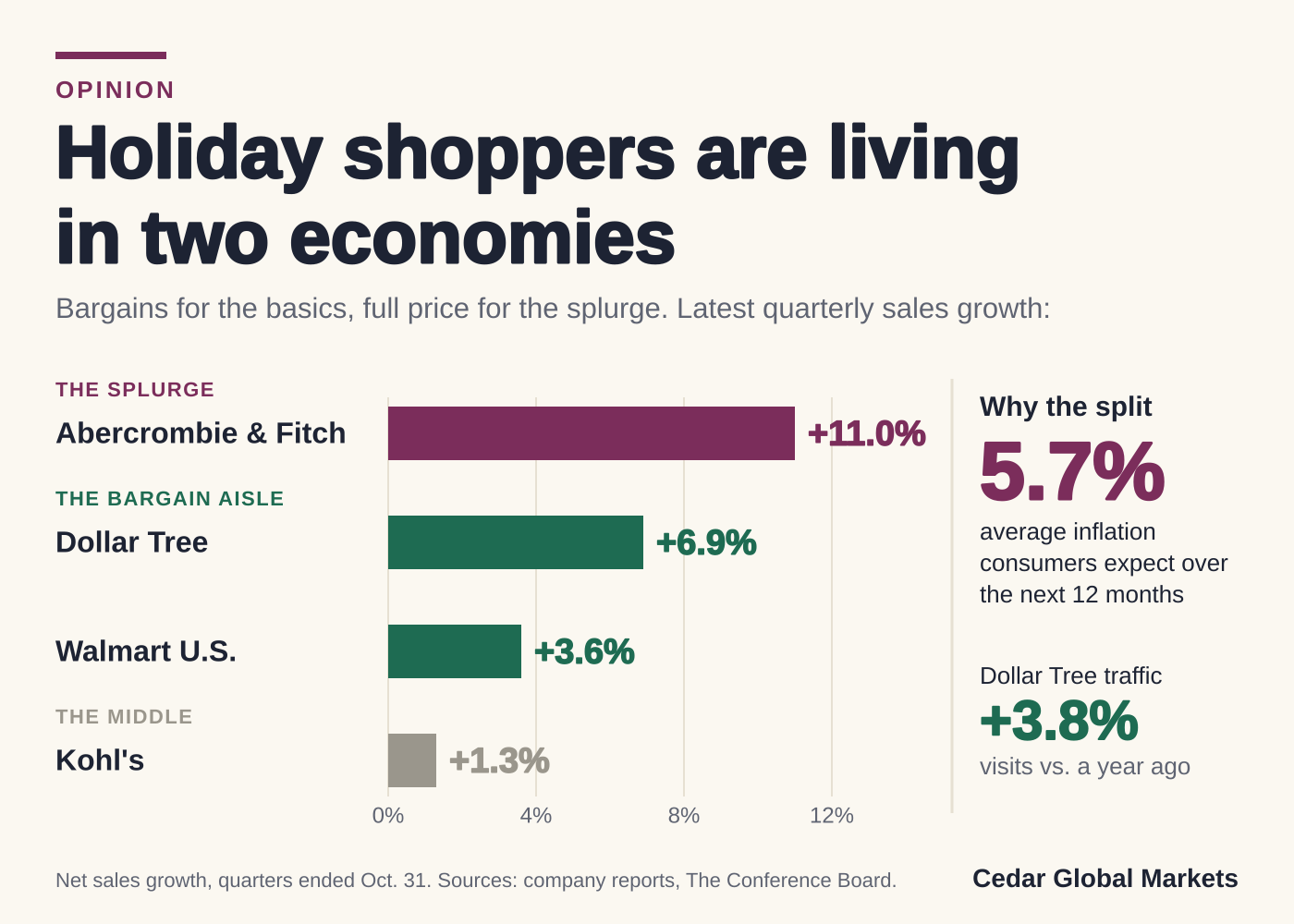
Start with the bargain aisle. Dollar Tree said traffic at stores open at least a year rose 3.8% in the quarter that ended Oct. 31, and its comparable sales rose 4.6%, above the top of its own forecast. More people walked through the door, and they spent only a little more per trip: the average ticket rose 0.8%. Total net sales grew 6.9%.
Those bargain hunters are not only families with tight budgets. Walmart, whose U.S. sales rose 3.6% in its latest quarter, said last week that its market share gains strengthened across income tiers, “led by upper-income households.” A year ago, Dollar Tree said about 60% of the new shoppers it added came from households earning more than $100,000.
Now look at the splurge. Abercrombie & Fitch said its sales rose 11% to $1.44 billion, a record for its third quarter, and that promotions were lower than it expected, which supported higher average prices. People paid closer to full price for the clothes they wanted.
Caught in the middle is the department store. Kohl’s said its sales grew again, but only by 1.3%.
Why the split? Prices are still the sore spot. The Conference Board’s consumer confidence index jumped to 103.3 in November, the highest since January 2025, but its economist said consumers “continued to express frustration with high prices and rising costs.” Consumers’ average expectation for inflation over the next 12 months eased but stayed high at 5.7%, the survey found.
That is a sensible way to run a household: cut hard on paper towels and snacks so there is room for a gift that matters. But it also means retailers are learning that shoppers will accept fewer discounts on the things they care about.
The lesson for this holiday season is not to spend less or more. It is to notice which economy you are shopping in. On the basics, the price fight is real and worth joining. On the splurge, the stores are betting you will not wait for a sale. Sometimes you should prove them wrong.
…
That’s the story. … Thank you for listening to Cedar Global Markets. We’re supported by our partners, and you can learn more about the partner featured on this page. We’ll see you next time.