
A year ago, the big question on Wall Street was how quickly the Federal Reserve would cut interest rates. Now the question is how far a Fed rate hike cycle will go. The central bank raised its key rate in September, held it steady in October, and the record of that October meeting shows that almost all officials expect to raise it again. The Fed’s next decision comes on Wednesday, Dec. 9.
This long read explains how the Fed got here, what the key numbers show, what has changed in recent weeks and what to watch before December’s meeting.
First, the background. The Fed’s main tool is the federal funds rate, the rate banks charge each other for overnight loans. It sets a target range for that rate, and it moves through the economy into what people pay on credit cards, car loans, business loans and, more loosely, mortgages.
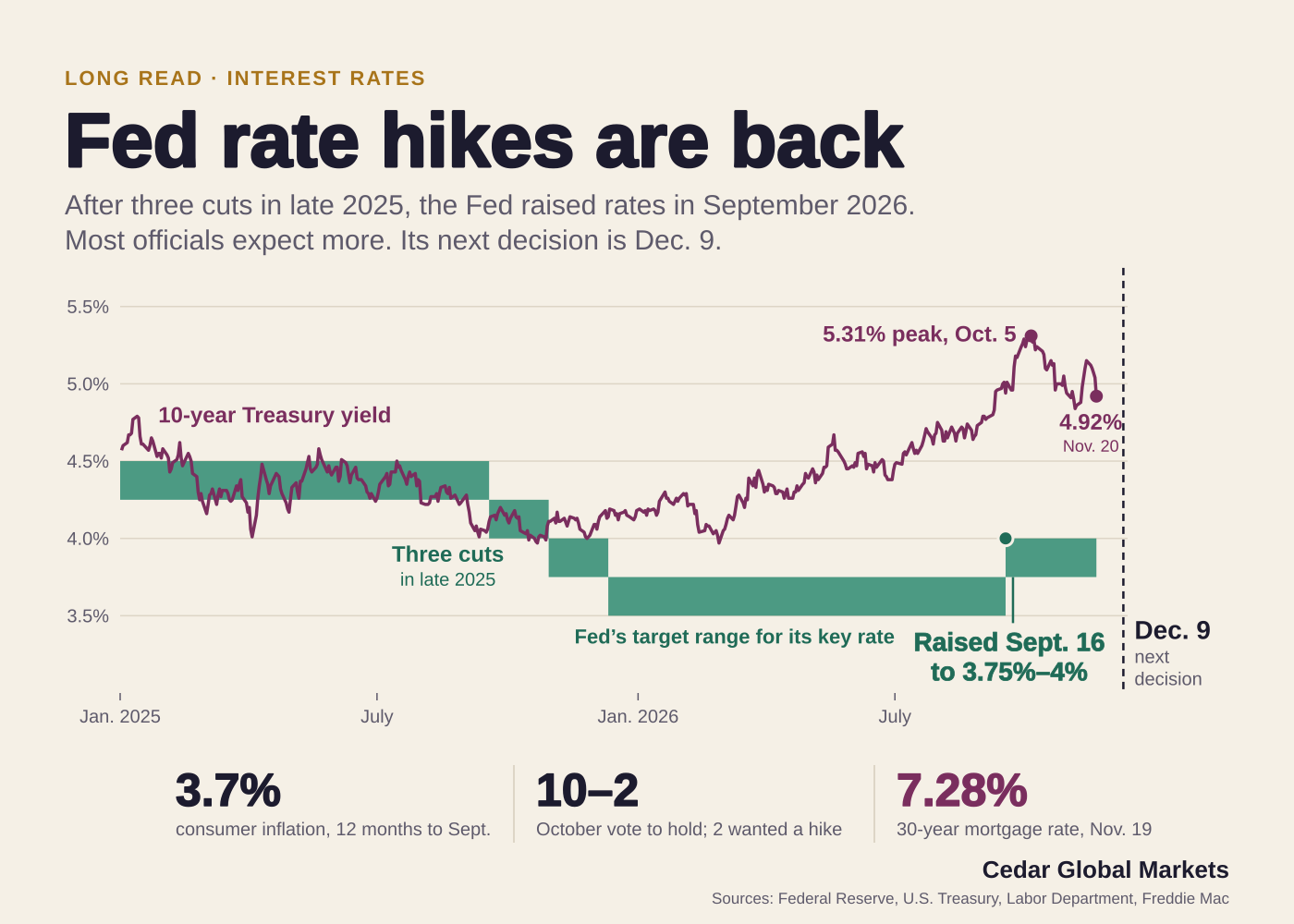
In late 2025 the Fed was cutting. It lowered the range three times, in September, October and December, bringing it down to 3.50% to 3.75%. It then held the rate there for most of 2026.
That changed on Sept. 16, 2026. The Fed’s rate-setting committee voted 12 to 0 to raise the range by a quarter of a percentage point, to 3.75% to 4%. Its statement was short and blunt: “Inflation remains elevated. Today’s policy action will support a timelier return to the Committee’s 2 percent goal. The Committee will deliver price stability.”
The reason is inflation that has not come down. The Labor Department’s consumer price index rose 3.7% in the 12 months through September. Fed Governor Lisa Cook said in a speech in Chile on Nov. 20 that inflation has been above the Fed’s 2% target for 67 months. Citing government data released the week before, she said the Fed’s preferred inflation gauge, the personal consumption expenditures price index, is estimated to have risen 3.8% in the year through October, and 3.2% when food and energy are left out.
October’s consumer price report showed prices still climbing: up 0.4% from September, and up 0.3% when food and energy are left out, the same monthly pace as in August and September. The Labor Department could not publish a 12-month figure for October because it did not collect price data in October 2025, during the federal government shutdown.
At the same time, the economy has stayed strong. Employers added 165,000 jobs in October and the unemployment rate was 4.1%, the Labor Department said. The economy grew at a 3.4% annual pace in the third quarter, Cook said.
On Oct. 28 the Fed held the range at 3.75% to 4%, but the vote was 10 to 2. Cook and Cleveland Fed President Beth Hammack voted against it because they wanted another quarter-point increase. In her Nov. 20 speech, Cook said holding steady will lead to “increasing inflationary pressure” and that the data since the September hike “fail to provide me with sufficient evidence that inflation is returning to a sustainable path.” Cedar covered Cook’s case for raising rates on Friday.
The minutes of the October meeting, released Nov. 18, show that the pause was not a change of direction. Almost all officials judged that further increases in the rate would likely be appropriate under their main forecasts. A couple said an increase of more than a quarter point could be considered at the next meeting if inflation data were unfavorable. A few called the decision to hold a close call.
The minutes also show where Wall Street expected rates to go at the time of that meeting. In the New York Fed’s survey of market participants, the median response expected one rate increase in December and another in March 2027, followed by a cut early in 2028.
Borrowing costs have already moved a long way this year. The yield on the 10-year Treasury note, a benchmark for long-term loans, was 4.19% on the first trading day of 2026, according to the Treasury Department. It peaked at 5.31% on Oct. 5 and was 4.92% on Nov. 20. The 2-year yield, which tracks expectations for the Fed’s rate closely, rose from 3.47% to 4.63% over the same stretch.
Home buyers have felt it. The average 30-year fixed mortgage rate in Freddie Mac’s weekly survey was 6.16% in early January. It reached 7.40% on Oct. 8 and Oct. 15, and stood at 7.28% on Nov. 19.
The Fed’s own minutes describe an economy split in two. Investment in artificial intelligence, manufacturing and data center construction was particularly strong, while housing and other sectors that depend on borrowing were weak. A majority of officials noted that financial conditions had tightened since September, pointing to higher mortgage rates and wider borrowing costs for riskier companies and for some AI-related borrowers.
Stocks have also come under pressure. The S&P 500 closed at 6,910.39 on Nov. 20, 11.6% below its record close of 7,818.93 on Oct. 6, and ended the week in a correction, a drop of at least 10% from a record. The Fed’s markets staff noted in the minutes that the higher interest rate environment had been weighing on stock prices for some time.
What has changed recently is the bond market. Treasury yields climbed until early October, mostly because economic data pointed to a strong economy, according to the minutes. After that, doubts about the revenue of key AI companies and about the pace of data center building, along with worries about France’s government debt, sent investors back into U.S. Treasury bonds. That pushed yields down from their October peak, even as the Fed signaled more increases.
The Fed is also under new leadership. Kevin Warsh is now its chairman. In his opening remarks at a Fed conference in San Francisco on Nov. 16, he spoke about artificial intelligence and productivity, and said Fed officials were “certainly not here to make predictions.” He did not discuss the next rate decision in those remarks.
Here is what to watch before Dec. 9.
On Wednesday, Nov. 25, at 8:30 a.m. Eastern time, the Commerce Department releases the official October inflation figures from the personal consumption expenditures index, along with its second estimate of third-quarter growth. Cedar’s guide to this week’s PCE inflation report lays out the schedule. At 2 p.m. that day, the Fed publishes its Beige Book, a survey of business conditions around the country.
On Friday, Dec. 4, the Labor Department releases the November jobs report.
The Fed meets on Dec. 8 and 9. Governor Christopher Waller noted in remarks on Nov. 20 that officials will give their views of the economy on Dec. 8 and of the right policy on Dec. 9. The decision is due Dec. 9, along with the Fed’s quarterly projections, which show where each official expects rates to go over the next few years.
The November consumer price report comes out on Dec. 10, the day after the decision, so officials will vote without it.
The big questions are how much higher rates go and for how long. The minutes point to more increases, but officials also said decisions depend on the data. Cook has called for another rise; others wanted to see how the September increase works through the economy first. Whatever the Fed decides on Dec. 9, the answer will reach borrowers through credit cards, car loans and mortgages in the months ahead.
…
That’s the story. … Thank you for listening to Cedar Global Markets. We’re supported by our partners, and you can learn more about the partner featured on this page. We’ll see you next time.