
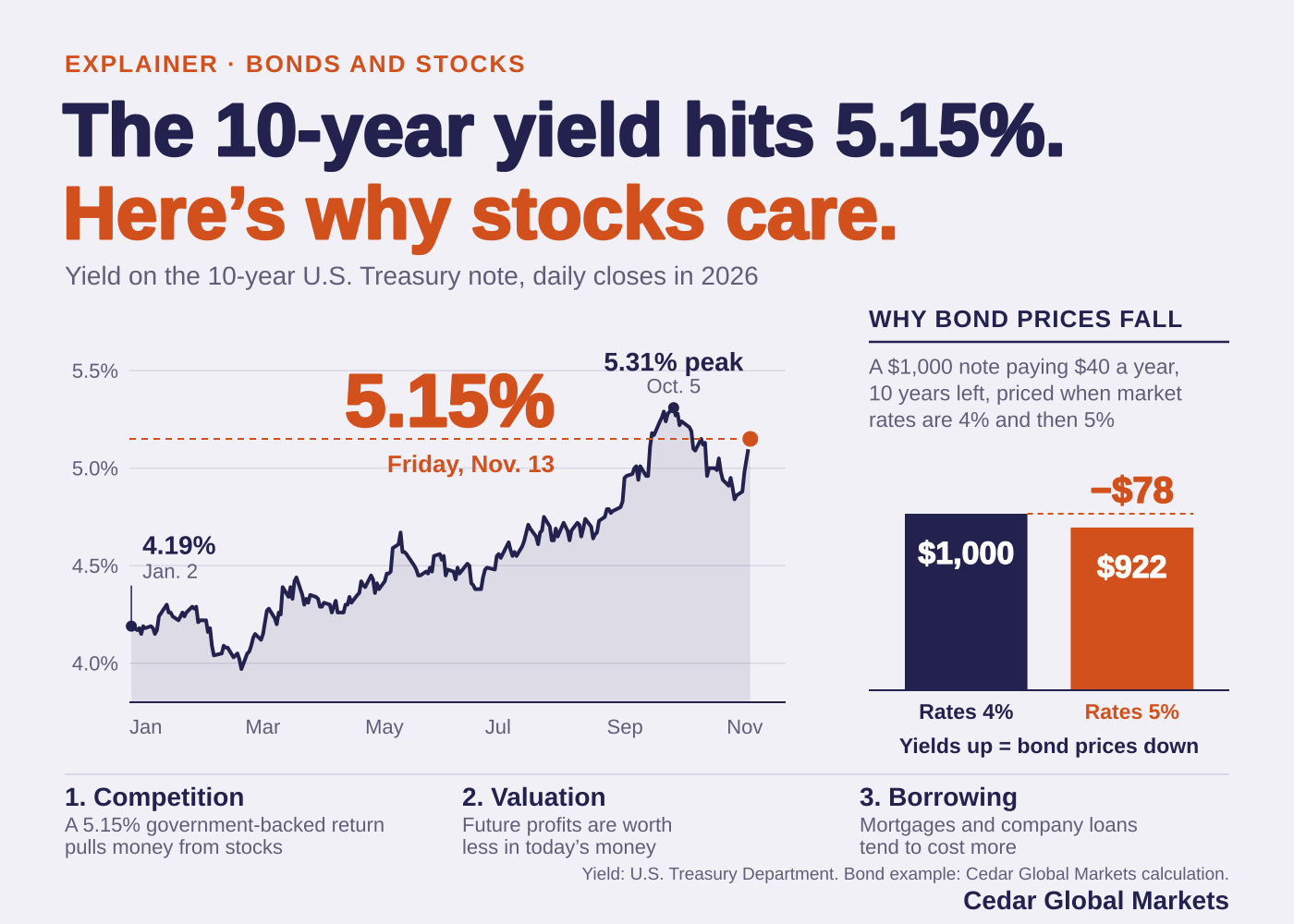
The yield on the 10-year U.S. Treasury note closed Friday at 5.15%, up from 4.86% a week earlier, according to the Treasury Department. It started the year at 4.19%. This week’s jump came after a hotter-than-expected inflation report on Tuesday and comments from Federal Reserve officials led traders to raise their bets that the Fed will lift interest rates in December. Few numbers are watched more closely on Wall Street. Here is what it is, and why it matters even to people who never buy a bond.
A Treasury note is a loan to the U.S. government. The buyer hands over money, the government pays a fixed amount of interest every six months, and it repays the note’s face value, the original loan amount, after 10 years. Notes keep trading between investors after they are sold, so their prices change every day. The yield is the yearly return a buyer would earn by paying today’s price and holding the note until it is repaid.
That is why prices and yields always move in opposite directions. Picture a $1,000 note that pays $40 a year, or 4%. If new notes start paying 5%, nobody will pay $1,000 for the old one. Its price has to fall, to about $922 for a note with 10 years left, until a buyer would also earn 5%. So when a headline says yields are rising, it means bond prices are falling.
The Fed does not set the 10-year yield. It sets a short-term rate, the rate banks charge each other for overnight loans, which is now in a range of 3.75% to 4%. The 10-year yield reflects what investors expect short-term rates to average over the next decade, plus extra return for tying money up that long and for the risk that inflation eats into it. News that points to higher inflation or higher Fed rates, like this week’s, tends to push it up.
The yield affects stocks in three main ways. The first is competition. A Treasury note is backed by the U.S. government and its interest payments are fixed. When it yields 5.15% a year, stocks, which offer no guaranteed return, have to look more attractive to win investors’ money.
The second is how investors value companies. A stock’s price reflects the profits a company is expected to earn for years to come, and analysts count future profits as worth less in today’s money when interest rates are high. Higher yields therefore lower what those future profits are worth today. Fast-growing technology companies, whose biggest profits are expected furthest in the future, are often hit hardest.
The third is borrowing costs. Rates on mortgages, corporate bonds and other long-term loans tend to move with the 10-year yield. When it rises, buying a home, building a factory or refinancing company debt costs more, which can slow spending and squeeze profits.
None of this works like a switch. Yields can also rise because the economy is strong, and a strong economy helps profits. This week, the S&P 500 rose 2.5% even as the 10-year yield climbed. Stocks and yields move for many reasons at once, and over short stretches they can rise or fall together.
For everyday readers, the 10-year yield is a quick gauge of how expensive money is across the economy. The next big tests for it include the monthly inflation reports and the Fed’s next rate decision, due Dec. 9.
…
That’s the story. … Thank you for listening to Cedar Global Markets. We’re supported by our partners, and you can learn more about the partner featured on this page. We’ll see you next time.