
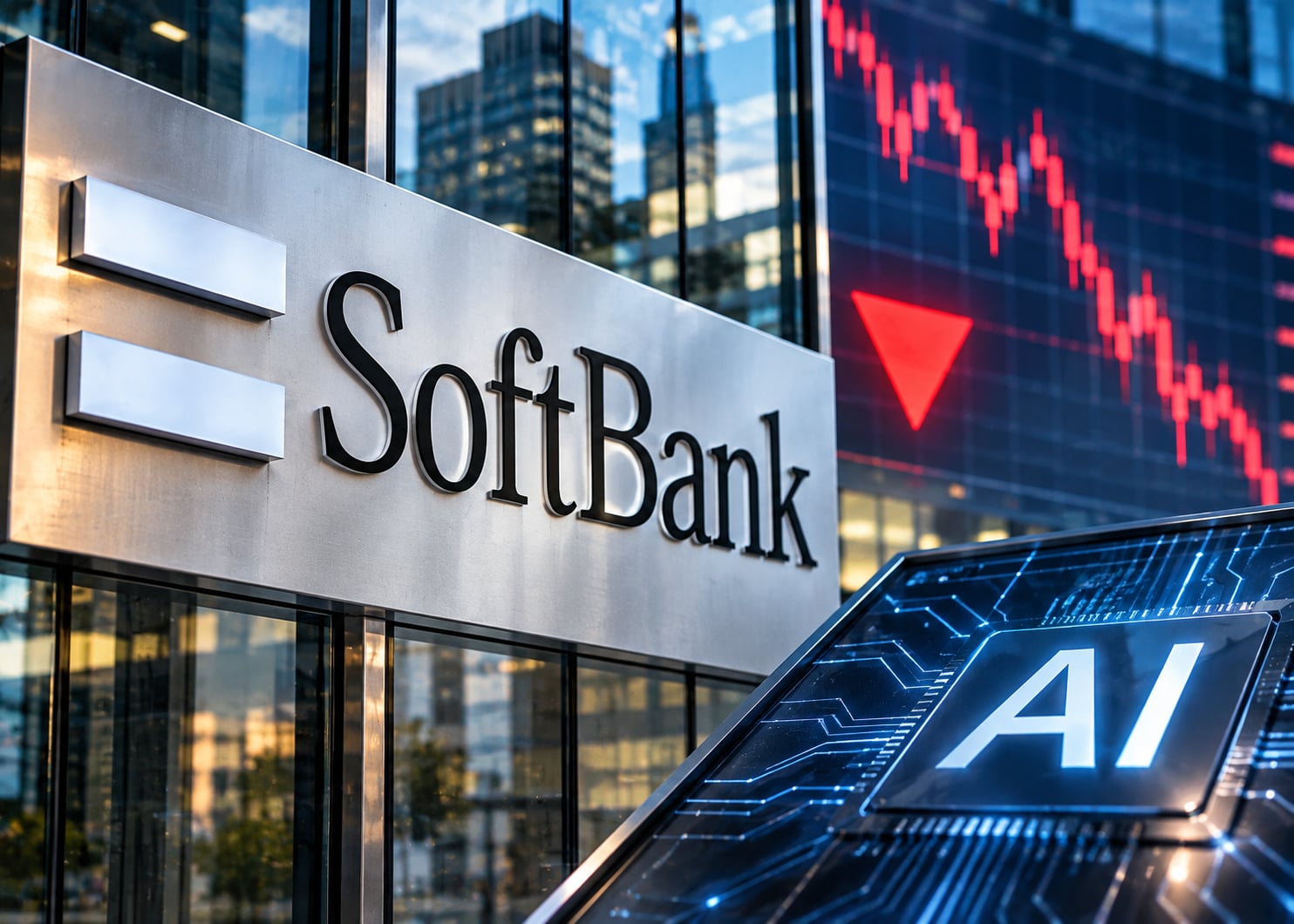
SoftBank Group’s borrowing-risk indicators reached their highest levels in four years Friday as investors reassessed the Japanese company’s financial exposure to artificial intelligence and data-center development.
The company’s five-year credit default swap spread rose 22 basis points to 466 basis points, its widest level since October 2022, according to Markit data cited by Reuters.
SoftBank shares declined approximately 10.8% during Friday’s trading, extending a substantial retreat from their September levels.
The selloff reflects growing concern about the cost of financing large-scale AI investments and the time required for those investments to generate returns.
SoftBank has invested approximately $64.6 billion in OpenAI and holds a roughly 90% stake in semiconductor designer Arm. It also has exposure to data-center development through SB Energy.
These investments connect SoftBank to several important parts of the AI industry, including computing infrastructure, semiconductor technology and advanced software.
However, the company has increased borrowing to finance its expansion, leaving investors particularly sensitive to changes in financing costs and expected returns.
The widening credit spread indicates that investors are demanding greater compensation to insure SoftBank debt against default. It does not, by itself, establish that the company will default.
The immediate question is whether SoftBank can maintain access to financing on acceptable terms while its major AI investments continue developing.
Investors will monitor credit spreads, borrowing costs and disclosures about the financial performance of its AI-related investments.
…
That’s the story. … Thank you for listening to Cedar Global Markets. We’re supported by our partners, and you can learn more about the partner featured on this page. We’ll see you next time.